Most people who start a home altar practice don’t fail because they chose the wrong objects. They spend weeks frozen – Do I need a real thangka? Is it disrespectful to use candles instead of butter lamps? My apartment faces west – does that matter? – before they ever settle.
These are not silly questions. But most guides answer them vaguely, carefully, and uselessly. This one won’t. By the end, you’ll know exactly what your Buddhist altar needs, what it doesn’t need, and why the distinction matters more than any of the details you’ve been worrying about.
Why Most Altar Guides Miss the Point
The fundamental mistake most beginners make is treating the altar as a decorative object-something to get aesthetically right before practice can begin. This leads to two problems. Either they spend money on expensive objects before having any practice to speak of, or they feel that a simple setup is somehow inadequate. Both are the same mistake, wearing different clothes.
What an altar actually is: a support for attention. It gives the mind a place to land. Over time, the smell of incense, the light of a candle, and the sight of a Buddha image begin to carry the mind toward stillness before a single breath is consciously taken. That is its function. Not decoration. Not display. A landing place for attention that keeps slipping away.
In Tibetan Buddhism specifically – the tradition this guide focuses on – the Buddha image does not represent an external deity to petition. It represents the possibility of an awakened mind. Your mind, at its most aware. Realising this transforms the way you approach the altar entirely. It is not meant as worship of something separate from you, but as a reminder of the awakened qualities already within. You are not worshipping something distant or outside your own experience. You are setting up a reminder of something within.
The one question worth asking about every object you consider placing there: Does this support my practice, or does it perform my practice for someone else? If the honest answer is the second one, it belongs somewhere else. Karma in Buddhist teaching accumulates through what we actually do, repeatedly, with intention -not through what we display.
The Tibetan Buddhist Altar: The Purpose Behind Every Object
A Tibetan Buddhist home altar at its most complete contains seven categories of objects. Understanding what each one means — not just what it is — is what separates a practice space from a decorative arrangement. Here is what each object is actually doing, and why it belongs.
The Buddha statue always occupies the central, highest position on the altar. Not very large and expensive. A small, simply cast figure carries the same meaning as an elaborate gilded statue from a specialist supplier. What matters is its placement – central, elevated, the point toward which everything else on the altar orients. The statue represents the enlightened mind as a real possibility within the practitioner. Not a god to ask favours from. Not an authority to fear. A quality of awareness that exists within every sentient being and can be cultivated. That understanding – kept in mind each time you sit – changes the quality of attention you bring to the space.
The thangka is a painted image, traditionally depicting a Buddha, bodhisattva, or mandala, hung above the altar rather than placed on it. The positioning matters — above, not beside. This is not hierarchy for its own sake. A thangka hung above the altar creates a vertical axis in the space: the statue below, the painted image above, and the practitioner between them. That spatial relationship has meaning. On the question every beginner asks — does it need to be an authentic hand-painted thangka? — the answer is no. A good quality print of a thangka serves exactly the same function for a home practitioner. The thangka’s purpose is to represent enlightened qualities and support attention. A printed image does both. Spend that money on retreat time instead.
The seven water bowls are the object most beginners either get wrong or skip entirely. They are not decorative. Each bowl represents one of the seven limbs of practice: prostration, offering, confession, rejoicing, requesting teachings, beseeching the Buddhas to remain, and dedicating merit. The daily ritual of filling them — left to right each morning — and emptying them — right to left before sunset each evening — is itself a practice. The water should be clean and poured carefully, without spilling. The emptying matters as much as the filling. This daily rhythm teaches non-attachment in a way that no book can: you build something in the morning and you release it in the evening, and you do this again tomorrow, and the day after. The bowls do not need to be silver. Ceramic works. Glass works. What matters is that they are filled with clean water and that you do it every day.
For a more detailed explanation of the seven limbs and their place in Tibetan practice, the guidance offered by Venerable Thubten Chodron at Sravasti Abbey is one of the most reliable resources available in English.
Butter lamps or candles represent awareness — specifically the quality of awareness that dispels the darkness of ignorance. In traditional Tibetan practice, butter lamps made from yak butter are used. In a modern home, a candle works. Light it when you sit. Extinguish it when you leave. A candle shouldn’t be left burning unattended. This is not a minor practical note — teachers say it explicitly because genuine devotion does not create fire hazards. If you find yourself leaving candles burning for hours while you go about your day, that is performance, not practice.
Incense represents ethics — specifically the quality of ethical conduct that spreads outward like fragrance and benefits others without requiring attention or effort. One stick is enough. Place the holder to the left of the altar from where you sit. The common mistake with incense is treating it as atmosphere — burning it to create a particular mood rather than as an offering with specific meaning. Understanding what it represents changes how it feels to light it.
The Dharma text is the most consistently overlooked element of a home altar, and its absence is a significant one. The Buddha, the Dharma, and the Sangha are the Three Jewels — the three foundations of Buddhist practice. Most beginners place a Buddha statue and stop there. But an altar without a Dharma text is missing one of its three foundations. Place a teaching you are currently working with near or beside the statue — a book of sutras, a commentary, a single printed page of teachings that matters to you right now. The text is not for display. It is for reading. An altar that includes a Dharma text is an altar that reminds you, every time you sit, that practice includes study.
A photograph of a spiritual teacher, if you have one, belongs on the altar — placed to the side of the Buddha statue, never above it or at the same level. If you do not have a teacher whose guidance you have formally received, leave this space empty for now. A photograph of a teacher you have never met, placed there because the image is beautiful, is closer to decoration than devotion.
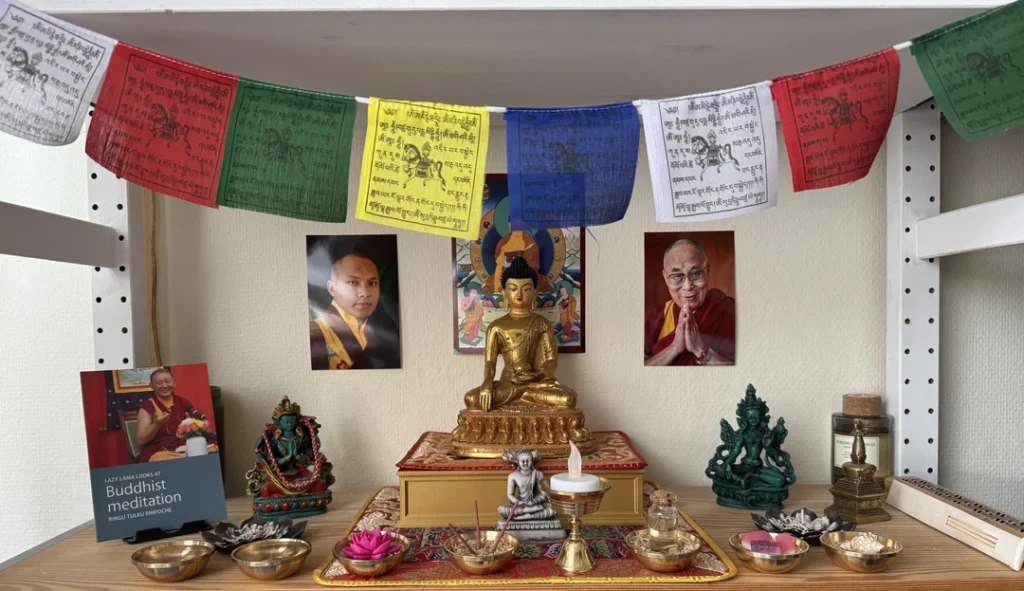
Image source: Reddit user u/Milagro2k from r/TibetanBuddhism
Placement, Height, and the Questions Everyone Googles
The placement mistake I see most often: choosing a spot that is beautiful but inconvenient to reach. You will not maintain a daily practice at a space that is physically annoying to access. A corner of your bedroom that requires moving furniture to reach will be abandoned within a month. Convenience is not laziness. It is a prerequisite for consistency.
On height: the altar should sit at or above eye level when you are seated in front of it. This matters practically – looking slightly upward creates a genuinely different quality of attention than looking down or across. A high shelf or a low cabinet with a dedicated surface both work well. A coffee table does not. The floor does not. If the only available surface is lower than ideal, raise the objects on it rather than accepting a downward gaze.
On which room: a dedicated corner of any room works. Teachers disagree on bedrooms-some advise against it, citing the association of that space with sleep and unconsciousness. My honest view, having seen many practitioners navigate this question in small apartments and shared houses, is this: if the bedroom is the only quiet, private space available to you, that is where the altar belongs. Respect is demonstrated through care, not room assignment. A well-tended altar in a bedroom is worth more than a neglected one in the correct room.
On facing direction: east is traditional across most Tibetan lineages, aligned with the direction of the rising sun and the associated symbolism of awakening. If you have a teacher, follow their guidance on this. If you do not, orient your altar toward whichever direction gives you a clean, uncluttered view and a comfortable seat. The direction matters less than showing up.
On shared homes: you do not need to make your practice a household statement. A shelf in your own space works. A cabinet that closes and contains the altar when not in use works. What rarely works is an elaborate altar installed in a shared living space without conversation – it can create tension that interferes with practice in a different way than any facing direction ever would. Keep the practice yours until there is a natural reason to share it.
Other Traditions: Zen, Theravada, and Vietnamese Buddhist Altars
Tibetan Buddhism is the focus of this guide, but it is not the only tradition with a home altar practice, and for some readers it will not be the right starting point. Here is an honest overview of the three other main traditions – enough to help a sincere beginner decide where to begin.
Zen altars are minimal as a philosophical position, not merely as an aesthetic one. One or two objects — a Buddha image, an incense bowl, perhaps a single flower — surrounded by intentional empty space. The emptiness is part of the teaching. In Zen practice, every element of the altar is there because it needs to be, and everything else is absent for the same reason. For practitioners drawn to simplicity as a practice in itself, rather than as a starting point before elaboration, a Zen-influenced altar is not an incomplete Tibetan altar. It is a different and complete thing.
Theravada practice focuses on the historical Buddha Shakyamuni rather than the elaborated pantheon of Tibetan Buddhism. The altar is simpler, with five traditional offerings: flowers, water, incense, light, and food. Those drawn to the Eightfold Path and the Pali canon often find Theravada a natural home. If you are interested in the original teachings of the Buddha before the later philosophical elaborations, this is the tradition to explore. The altar reflects that directness.
Vietnamese Buddhist practice weaves together devotion and ancestor veneration in a way that most guides ignore entirely. Photographs of deceased family members sit alongside the Buddha image, and offerings carry intention for both the awakened and the departed. This is not syncretism or confusion — it is a coherent, ancient integration of Buddhist devotion with the care for family that runs through Vietnamese culture at every level. If this combination reflects something in your own background or sensibility, it is worth researching seriously rather than dismissing as non-traditional.
For beginners without a tradition — and with no living teacher or community accessible nearby — begin with the simplest Theravada setup: one Buddha image, five offerings, a clean surface. Master simplicity before elaboration. The Tibetan system, with its seven bowls and its thangkas and its complex iconography, rewards practitioners who already have some familiarity with the philosophy. Begin with what you can maintain honestly, and let the practice deepen from there.
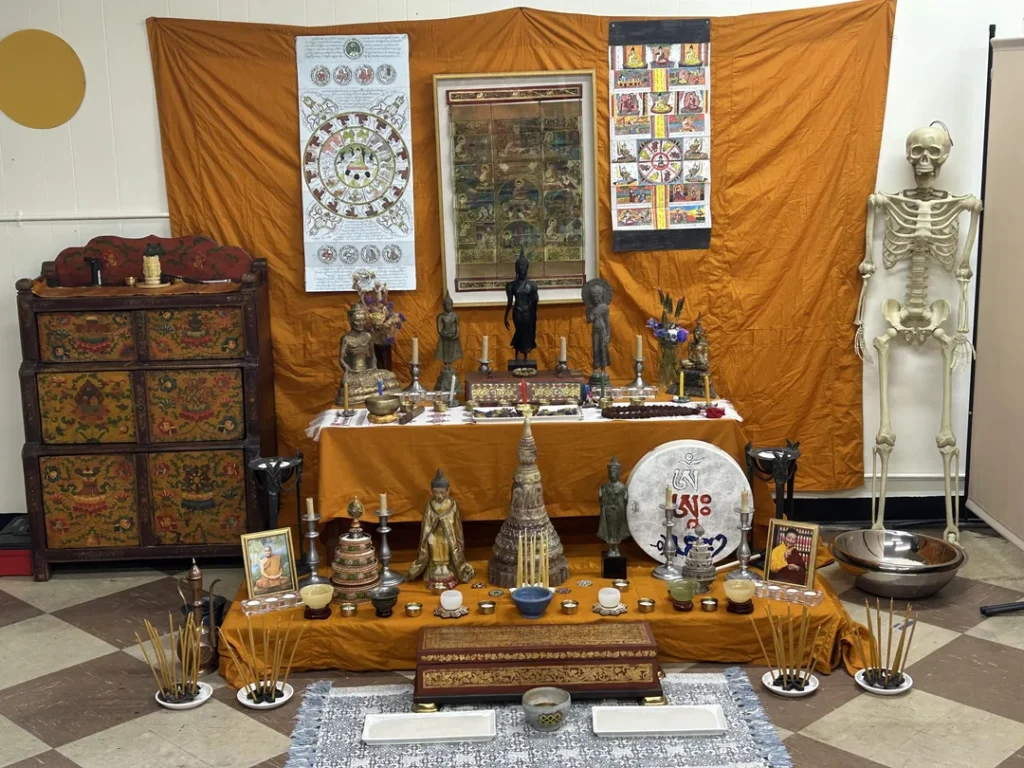
Image source: Reddit user u/Awkward_Command8236 from r/Buddhism
The Daily Practice: What You Actually Do at the Altar
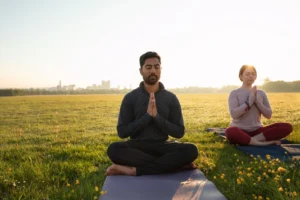
There is a kind of morning every practitioner knows. You woke up late. The incense ran out two days ago and you have not replaced it. You are tired in a way that has nothing to do with sleep. Even a simple Buddhist morning routine can help create a small space of calm before the rest of the day begins.You sit down for two minutes because that is all there is.
You fill the water bowls. The water is cold from the tap. You light one candle because the incense is gone. You take three breaths. Nothing happens — no peace, no stillness, just the mind already running through the day ahead.
And then, in the pause before you stand: the recognition that you came back. That this small, inadequate, two-minute version is also the practice. The altar did not need the incense or the extra time. It only needed you to show up.
That is what a daily altar practice produces over time. Not consistent bliss. Not reliable peace. A deepening familiarity with the act of returning. The capacity to come back, again and again, to something that matters — even on mornings when nothing in you wants to. That is worth more than it sounds.
If you are still building a daily routine, this guide on how to practice Buddhism at home can help you develop a simple structure around meditation, chanting, mindful breathing, and reflection.
Over years of practice and study within the Tibetan Buddhist tradition, the most consistent observation is this: the practitioners who maintain something real are almost never the ones with the most elaborate altars. They are the ones who show up on the difficult mornings. The altar is not the practice. It is the place where the practice happens. Keep that distinction alive and the rest takes care of itself.
What You Do Not Need on Your Buddhist Altar
You do not need an expensive thangka before you have a practice. The thangka serves the practice – if there is no practice yet, the thangka is serving the idea of practice, which is a different and less useful thing.
You do not need multiple statues from different Buddhist traditions arranged together without understanding what each one means. A Tibetan Avalokiteshvara beside a Theravada Shakyamuni beside a Zen Bodhidharma, mixed without knowledge of their distinct contexts, creates visual confusion rather than richness. The altar is a focal point. Focal points require focus, not accumulation.
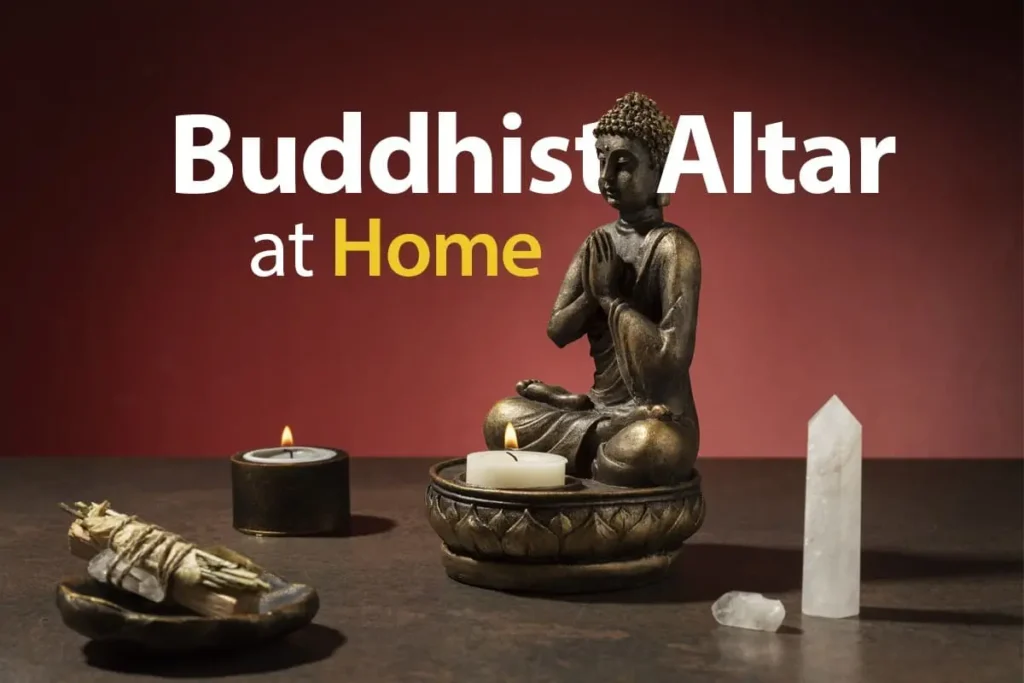
You do not need crystals. Crystals have their own traditions and their own logic, but that logic is not Buddhist logic. Placing them on a Buddhist altar because they feel spiritual is the kind of decision that looks like openness and functions like noise. If crystals are meaningful to you, give them their own space.
You do not need a singing bowl. It is lovely. It is optional. It is not part of traditional altar practice in any of the main Buddhist lineages. If you enjoy it as part of your sitting practice, keep it nearby. It does not belong on the altar itself.
Most importantly, you do not need an altar so elaborate that it becomes an obstacle — always being refined, always awaiting one more object, never quite ready for actual sitting. The altar that is perpetually being perfected is the altar that is never being used.
A single Buddha image, a clean surface, and a bowl of fresh water is genuinely sufficient to begin. The elaborateness is optional. The intention is not.
Conclusion
The altar does not care whether the thangka is hand-painted or printed. It does not care whether the bowls are silver or ceramic, whether the room faces east, whether the incense is Tibetan or Indian or absent entirely.
What it responds to — to the extent that objects respond to anything — is whether the person sitting in front of it comes back tomorrow.
Come back tomorrow.
To explore more on Buddhist practice and philosophy, visit the Buddhist Insights section of Hidden Mantra — where the tradition is treated with the seriousness it deserves.
Frequently Asked Questions
Do I need an expensive thangka for a proper Tibetan Buddhist altar?
No. A print serves the same function for a home practitioner. The thangka’s purpose is to represent enlightened qualities and support attention — a printed image does both. Authenticity of practice matters more than authenticity of materials.
How high should a Buddhist altar be?
At or above eye level when seated in front of it. This affects the quality of attention in a practical, observable way. A high shelf or cabinet works well. The floor does not. The altar should never require you to look down at it.
Can I put a Buddhist altar in my bedroom?
Yes, if it is the quietest and most private space available to you. Keep it clean, separate from clutter, and not at the foot of the bed. Respect is demonstrated through care, not room assignment.
What is the minimum a Buddhist altar needs?
A single Buddha image, a clean surface, and one offering — even just a bowl of fresh water. Everything else is an addition to practice, not a requirement for it.
Why do Tibetan Buddhist altars have seven water bowls?
Each represents one of the seven limbs of practice: prostration, offering, confession, rejoicing, requesting teachings, beseeching the Buddhas to remain, and dedicating merit. Fill them left to right each morning, empty them right to left before sunset. The daily act is itself a practice in consistency and non-attachment.
Can I mix objects from different Buddhist traditions on one altar?
Only if you understand what each object means and why it is there. Mixing without understanding dilutes the focal quality of the altar. An altar is not a collection. It is a point of return.
What should I do if I miss days or my altar gets neglected?
Come back without self-criticism. Wipe the surface, refresh the water, sit for one minute. Beginning again is not a failure — it is the practice itself.