Table of Contents
ToggleHeard someone say, “I will go on the path of spirituality”, and ever thought what is this spirituality?
To understand simply, spirituality is a belief that there is something beyond yourself, and at some point in life, almost everyone starts to think about these.
According to indian philosophy, the path towards spirituality leads to the powerful idea called Moksha, it represents the ultimate goal of human life. While we spend all our time chasing success, relationships, and comfort, somewhere, as our ancestors say, lasting peace lies somewhere deeper.
Let’s understand what Moksha really means and why it matters.
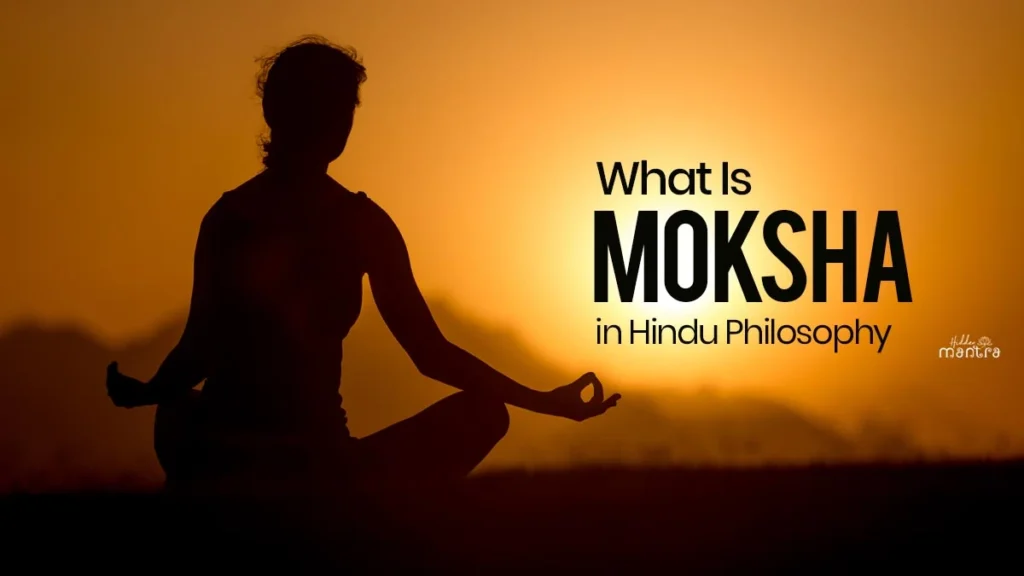
Meaning of Moksha
The meaning of the Sanskrit word Moksha is ‘to free or release one from bondage.”
So when we speak of Moksha, we are speaking of the end of all suffering, and all that is confusing, painful, or difficult to deal with in our everyday life.
You can view it as the end of the repetitive cycle of life known in Hinduism and Buddhism as Samsara.
Another term commonly used for Moksha is Mukti, or spiritual liberation.
When someone achieves Moksha, they achieve the end of suffering, ignorance, and all of the emotional turmoil of life. This is viewed as a state of eternal peace, true bliss, and complete psychological freedom.
Looking at it, it is like awakening from a dream to discover that you see everything and everyone with clarity and serenity as a unified whole.
Why Moksha Is the Ultimate Goal of Life
You might wonder – why is Moksha considered so important?
Because it solves the root problem of human life.
- It ends the cycle of samsara — no more repeated births and deaths.
- It removes suffering, which is often caused by attachment and ignorance.
- It leads to self-realization — understanding who you truly are beyond body and mind.
- It brings a sense of unity with the divine, or universal consciousness.
- Most importantly, it gives lasting peace, not temporary happiness.
Everything else in life can come and go. Moksha is about something permanent.
Moksha in Hindu Philosophy
In Hindu philosophy, life is guided by four main goals, known as the Purusharthas:
- Dharma – living with duty and righteousness
- Artha – earning wealth and stability
- Kama – fulfilling desires and enjoying life
- Moksha – achieving liberation
The first three help us live a balanced and meaningful life. But Moksha stands above them all – it is the final destination.
It doesn’t reject life; instead, it completes it.
The Concept of Samsara
To understand Moksha, we need to understand what it frees us from –Samsara.
Samsara is the endless cycle of:
- Birth
- Death
- Rebirth
This cycle is driven by karma, which means our actions. Every action leaves an impression, and these impressions shape future experiences — even future lives.
It’s like being caught in a loop.
Moksha is the moment when this loop finally breaks. The soul is no longer bound by karma or rebirth. It becomes free.
Moksha in Different Indian Traditions
Across India’s rich spiritual traditions, the idea of liberation takes different forms, yet all point toward ultimate freedom and inner peace.
Hinduism
In Hinduism, Moksha is about realizing that your true self (Atman) is one with the ultimate reality (Brahman). It’s a journey of knowledge, devotion, and inner discipline.
Buddhism
Buddhism speaks more about Nirvana rather than Moksha. It is the end of suffering and desire. Instead of focusing on a soul, it focuses on letting go of attachment and ego.
Jainism
In Jainism, Moksha is achieved by purifying the soul through right knowledge, right faith, and right action. It emphasizes non-violence and self-discipline.
Each tradition has its own path, but the goal is similar – freedom from suffering and the cycle of rebirth.
Can Moksha Be Achieved in This Life?
This is a question many people ask: Is Moksha only after death?
There are two important ideas here:
Jivanmukti (Liberation while living)
This means a person can achieve Moksha while still alive. They live in the world, but are no longer attached to it. They experience peace regardless of circumstances.
Videhamukti (Liberation after death)
This happens when a liberated soul leaves the body and is completely free from the cycle of rebirth.
So yes -Moksha is not just a general idea. It is something that can begin here and now, through awareness and inner growth.
FAQ
What is the goal of Moksha?
The ultimate goal of moksha (moksha) is to be released from all cycles of life and experience ultimate tranquility. Mankind desires to attain moksha to attain eternal happiness and have an understanding of one’s true self.
What is Moksha in spirituality?
Moksha within spiritual traditions signifies liberation (release from) from all forms of suffering, ignorance, or attachment, which leads to an individual attaining a state of peace within themselves and being one with (or not) the divine.
What are the 4 ends of life?
The four purposes of human existence are: (1) Dharma; (2) Artha; (3) Kama; and (4) Moksha.
How does the concept of Moksha differ from Mukti in Indian philosophical traditions?
There is no material difference; therefore, moksha and mukti are often used synonymously and refer to spiritual liberation
Conclusion
Moksha means understanding life rather than escaping it. Moksha is the search for peace within ourselves that is independent of anyone or anything else.
While Moksha can seem like a distant or spiritual concept, there are many ways we can begin to experience this state of being through small steps such as self-awareness, self-reflection and consciousness.
If you’re curious to explore more about spiritual growth, mindfulness, and deeper wisdom, you can visit Hidden Mantra a space that shares insights to help you connect with your inner self.