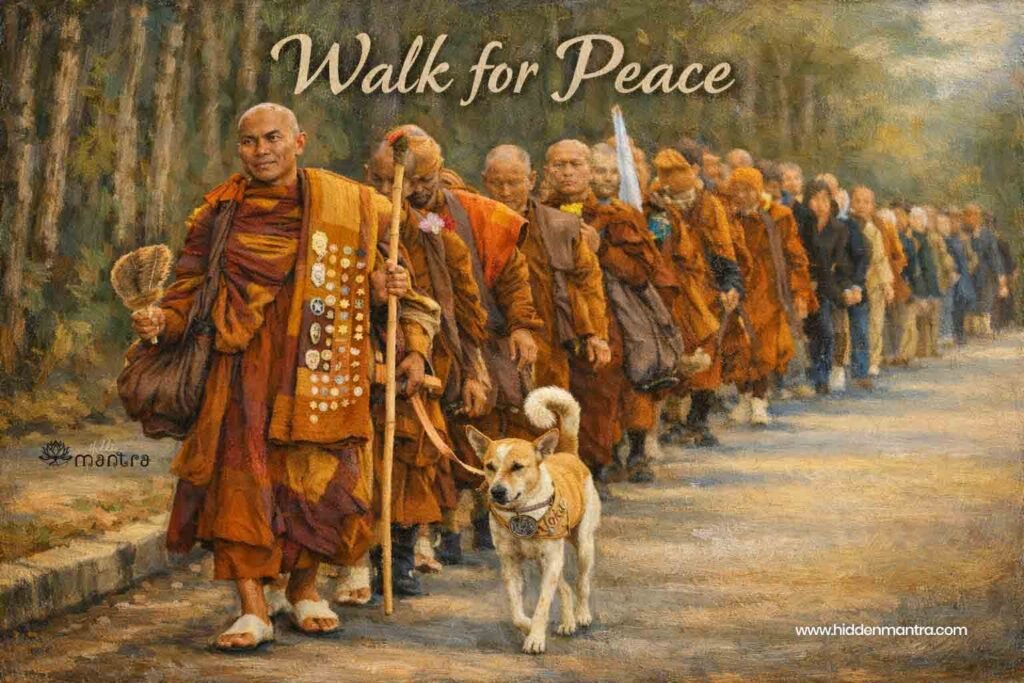
Growing the world seems more divided by discord and trepidation, but some of the most effective change movements come in the most silent forms. One of such movements is the Walk for Peace, a long-distance pilgrimage that transforms simple walking into deep compassion, mindfulness, and nonviolence. It is not propelled by words or demonstrations, but by being, willfulness, and human communication.
What Is a Peace Walk?
A Peace Walk is a conscious walk that is done on foot in the name of peace, harmony, and understanding among the people. Peace walks, in contrast to the demonstrations that are based on resistance or anger, are focused on inner peace, a sense of community, and peaceful action. The participants take a slow and conscious pace of walking, frequently without talking or muttering prayers, but with every step they take being an extension of their own dedication to peace.
The peace walks may be in various forms. Others take a couple of hours, others span states or even nations. It does not matter how far, the idea behind this remains the same, that is, to remind people and the community that peace is not global, but it is their individual obligation. It turns into a spiritual practice of walking, a practice that unites the heart, mind, and body.
In its most fundamental concept, a peace walk educates us that there is no waiting until we have peace. It is something we practice.
Who Organizes the Walk for Peace Program
The Walk for Peace is a long-distance pilgrimage in the United States that was started by 19 Buddhist monks of the Huong Dao Vipassana Bhavana Center in Fort Worth, Texas. The walk is based on the teachings of Vipassana meditation and directed by such principles as mindfulness, compassion, and nonviolence.
They were launched on October 26, 2025, in a Vietnamese Buddhist temple in Texas. It is there that monks walked, going through towns, cities, and country communities over 2,300 miles (3.700 km). The pilgrimage is to end in mid-February 2026 in Washington, D.C. where the monks intend to professionally petition the U.S. Congress to declare the day of birth and the day of enlightenment of Buddha a federal holiday.
Although such a request has a national meaning, the monks underline that their mission is much beyond one destination or a political result. What they care most about is their ability to connect with individuals along the path, to listen, have some time of mindfulness, and bridge the gaps of understanding wherever they go.
Spiritual Roots of Peace Walks
Walking is a spiritual practice that has a very long history. Walking meditation is one of the central practices of Buddhism, which is used in combination with sitting meditation. Every step is done consciously, and the practitioner is made to be present and develop an understanding of what the mind is like.
This tradition is heavily tapped by peace walks. The simplicity with which the monks conduct their lives is manifested through their simplicity and a handful of things they carry around, which symbolize detachment and humility. Their gradual and gentle motion is in contrast with the hectic rhythm of contemporary life, making the observers stop and reflect.
Peace walks reverberate spiritual traditions of the world beyond Buddhism. Walking is a holy activity as accepted in Hindu pilgrimages, Christian processions, Islamic journeys, and Indigenous walking rituals of the world. Going through land is also an option to heal, to pray, and to feel unconnected to something bigger than oneself.
Peace walks, therefore, cut across religion. They are global spiritual English speakers, that is, they respect life, the present, and compassion.
Aloka the Peace Dog
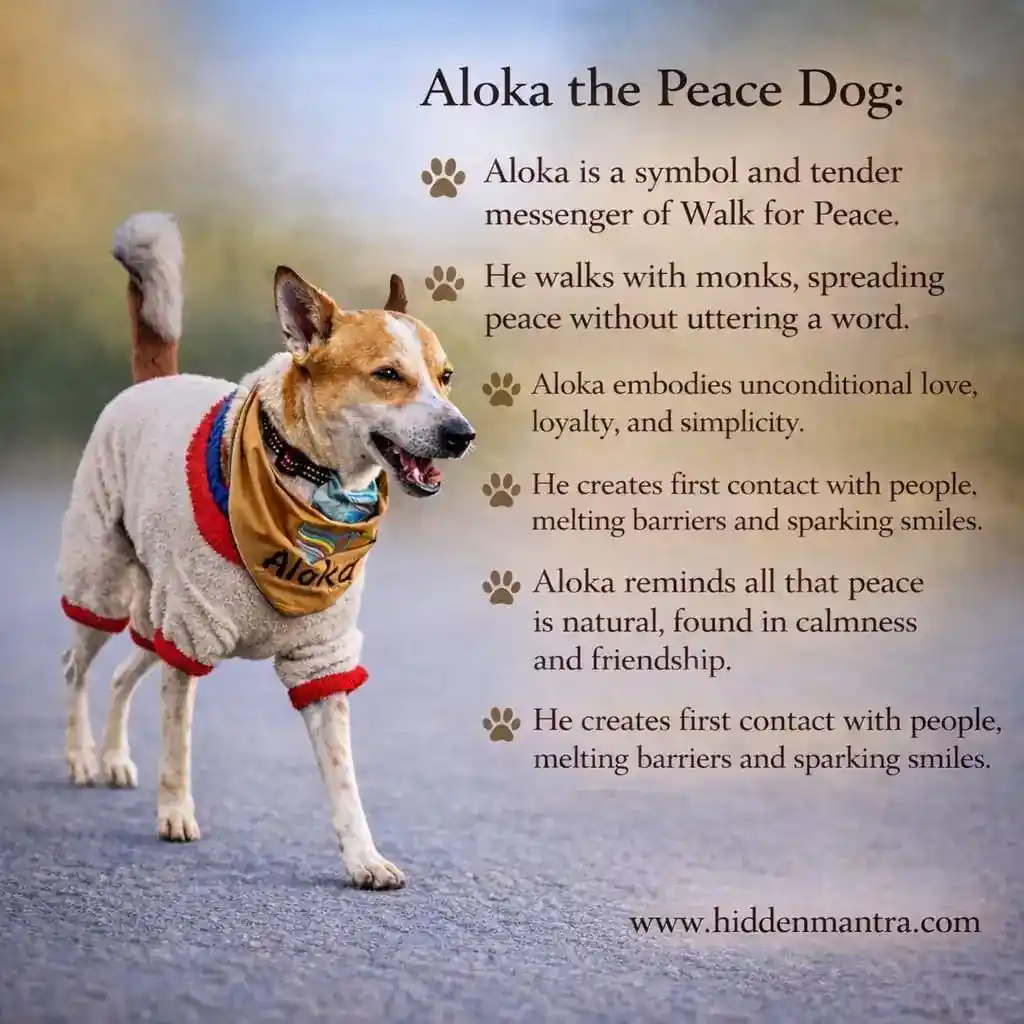
Aloka the Peace Dog is one of the most renowned symbols of Walk for Peace. Aloka, who is walking with the monks, has turned out to be a tender messenger of the message of the journey. Aloka conveys peace by being there without uttering a word or even preaching.
Dogs do not judge, prejudice, or have an ego. Aloka is unconditional love, loyalty, and simplicity, which are the main values of the spirit of the peace walk. The pilgrimage is something new to everyone, and it is usually the Aloka who creates the first contact point. Smiles are shown, conversations start,t and barriers are smoothed over.
The role of Aloka is not symbolic. The Peace Dog serves to remind the participants and the viewers that peace is a natural thing. It is in calmness, good nature, and friendship. At times, the greatest of teachings comes with no words.
Why Peace Walks Matter Today
In today’s world of constant information, polarization, and unrest, peace walks hold deep relevance. News cycles thrive on conflict, social media amplifies division, and silence has become rare. Peace walks offer a counterbalance to this noise.
They matter because they:
- Create visible acts of nonviolence in public spaces
- Encourage connection beyond culture, belief, or identity.
- Offer moments of stillness in a fast-moving world.
- Respond to conflict with compassion rather than confrontation.n
- Inspire people to reflect on their own role in creating peace.
Relationships are also an essential truth, as the monks emphasize the need to meet people on the way. An evening stroll, a short talk, or even positive contemplation may make an impression. Such minor interactions reverberate and form the communities in subtle yet significant ways.
Peace walks make us remember that transformation does not necessarily have to start in large systems. In many cases, it starts with one human experience.
Conclusion
The Walk For Peace is not just a trip to walk from Texas to Washington, D.C. It is a soul-touching meditation, a prayer, and a call to remember that it is the responsibility of all mankind. The pilgrimage is a collaboration of ancient wisdom and modern intent initiated by Buddhist monks of the Huong Dao Vipassana Bhavana Center.
With the monks taking one step after another, watching their minds, and having along with them Aloka the Peace Dog, they show that peace is not an abstract concept. It is an experience that is lived and exercised by being present, humble, and compassionate.
If you are more into spirituality, do follow the Hidden Mantra and Hidden Mantra blogs.
FAQ
Where did the monks start walking from?
The monks started their Walk for Peace on October 26, 2025, in a temple of Vietnamese Buddhism in Texas, which is connected to the Huong Dao Vipassana Bhavana Center in Fort Worth. Out of that, they embarked on a long-distance pilgrimage journey across the United States, walking consciously across communities on their path to Washington, D.C.
What happened to Aloka the Peace Dog?
The Peace Dog, Aloka, is still alive, and it is a great symbol of the Walk of Peace. Aloka was walking with the monks as the image of unconditional love, presence, and harmony. It could be physically present on all levels or merely recalled as a symbol. The role that Aloka plays is really profound, as it helps to keep in mind that peace is natural, soft, and it is not an imposing judgment.
What does it mean when monks walk for peace?
It is a form of living meditation when the monks walk in order to get peace. Every action is deliberate, conscious, and caring. The walk symbolizes nonviolence in action, that peace starts in the person and radiates outwards through awareness, humility, and human relationships, and not through coercion and conflict.
Why are the monks walking to Washington, D.C.?
The monks intend to end the trip in mid-February in Washington, D.C., where they will politely petition Congress to recognize the birthday and enlightenment of Buddha as a federal holiday. More than this demand, their hidden agenda is to reach out to the people nationwide and be a catalyst for peace by their presence.
Can ordinary people join or support a peace walk?
Yes. Peace walks are participatory in nature. Individuals can also accompany the monks to whatever distance, support them, or just have a chat. Sightseeing the walk or even thinking about the message is regarded as an efficient type of involvement.