Table of Contents
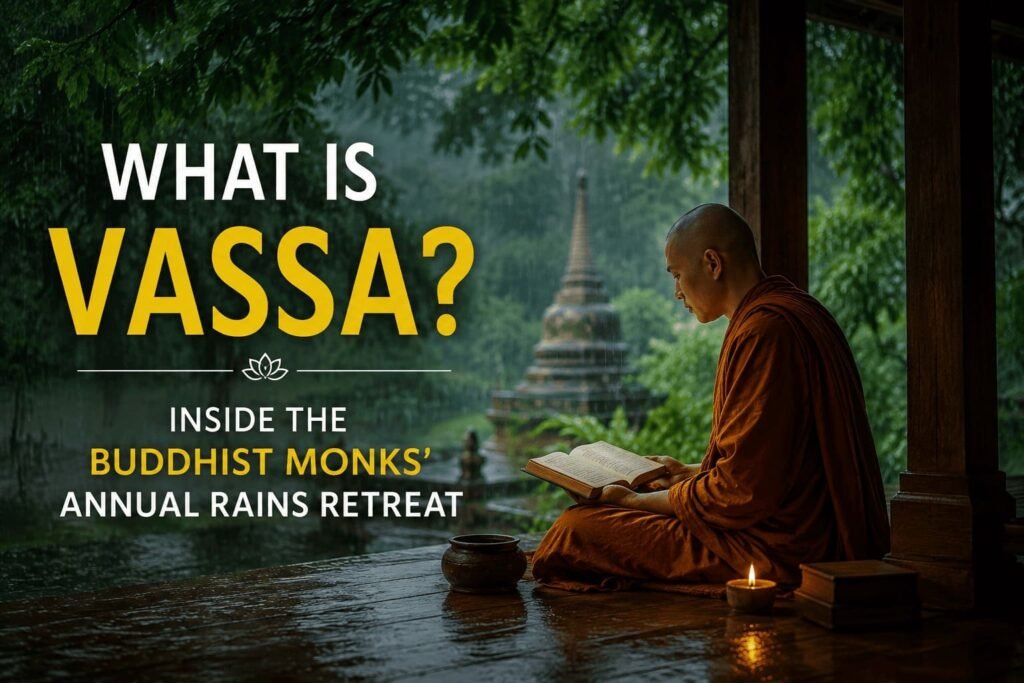
ToggleEvery year, when the monsoon clouds break over Southeast Asia and the roads turn to mud, thousands of Buddhist monks quietly stop walking. For three months, they will not leave their monastery except in emergencies. No almsround through distant villages. No travel between temples. Just one place, one routine, and a depth of practice most people never have the discipline to attempt.
This is Vassa — and it’s been happening, unbroken, for over 2,500 years.
What Vassa Actually Means
Vassa (also spelled Varsa) is Pali for “rain” or “rainy season.” It refers to the three-month period, roughly from July to October, when monks in the Theravada tradition — practiced across Thailand, Myanmar, Sri Lanka, Laos, and Cambodia — remain in a single residence instead of wandering as they normally do.
It’s often called “Buddhist Lent” in the West, though the comparison is loose — Vassa isn’t about fasting or giving something up (though many lay Buddhists do take on personal vows during this time). It’s about stillness as discipline.
Why the Buddha Started It
Before Vassa existed, monks lived as wandering ascetics year-round, walking from village to village regardless of season. During the monsoon, this created a real problem: the rains bring out new crops, insects, and small creatures, and monks travelling on foot were unintentionally trampling farmers’ fields and killing insect life underfoot.
Lay communities complained. Other wandering ascetic groups of the time had already adopted the practice of pausing during monsoon out of the same concern. The Buddha, hearing the criticism, instituted Vassa as a formal rule: monks would settle in one place for the three monsoon months, both to avoid this harm and to deepen their own practice without the disruption of constant travel.
What started as a practical, almost logistical decision became one of the most spiritually significant periods in the Buddhist calendar.
What Happens During the Three Months
Vassa isn’t a passive waiting period. For monks, it’s the most intensive stretch of practice in the entire year.
- Meditation deepens. Techniques like Vipassana are often practiced with far greater intensity during Vassa, since there’s no travel to interrupt the routine.
- Study intensifies. Scripture study, teaching, and mentorship of younger monks happens more formally during this window.
- Movement is restricted. Monks are permitted only short absences (traditionally no more than seven nights) for genuine emergencies — a sick parent, an urgent teaching request. Anything longer breaks the retreat.
- Lay communities step up. Since monks can’t travel to receive alms from distant villages, the local lay community takes on the responsibility of supporting them daily — food, robes, medicine — for the full three months. This exchange is central to Vassa: the monks give focused practice, the lay community gives sustained support.
In Thailand, the start of Vassa is called Khao Phansa, and it’s common for lay Buddhists to mark the day with their own personal vow — many choose to quit smoking, drinking, or another habit for the same three months, treating it as a shared season of discipline rather than something only monks observe.
How Vassa Ends: The Kathina Ceremony
Vassa closes on Pavarana day, the full moon marking the end of the retreat. But the more visible celebration comes shortly after, in the Kathina ceremony — one of the most important lay-monastic events of the year.
During Kathina, the lay community formally presents new robes and requisites to the monks who completed the full retreat, as a gesture of gratitude for their three months of intensified practice. It’s festive, communal, and often involves the whole village or temple community, standing in sharp contrast to the quiet discipline of the months before it.
Why Vassa Still Matters Today
In an era where almost nothing asks for sustained, uninterrupted commitment, Vassa is a 2,500-year-old answer to a very modern problem: the inability to sit still with anything. Monks don’t observe Vassa because travel is inconvenient during monsoon anymore — they observe it because the practice of staying has its own value, one that’s arguably harder to find today than it was when the Buddha first set the rule.
FAQ
What does Vassa mean?
Vassa is Pali for “rain” or “rainy season,” referring to the three-month period when Buddhist monks remain in one location instead of traveling.
When does Vassa take place?
Vassa typically runs from July to October, aligned with the monsoon season in South and Southeast Asia, beginning on Asalha Puja and ending on Pavarana day.
Is Vassa the same as Buddhist Lent?
It’s sometimes called that informally, but Vassa isn’t about fasting — it’s about monks staying in one place for intensive practice, and lay Buddhists often taking on personal vows during the same period.
What is the Kathina ceremony?
Kathina is the celebration held after Vassa ends, where lay communities offer new robes and requisites to monks who completed the full retreat.
Do all Buddhist traditions observe Vassa?
Vassa is primarily observed in Theravada Buddhism (Thailand, Myanmar, Sri Lanka, Laos, Cambodia). Mahayana and Vajrayana traditions have related but differently structured retreat practices.