Table of Contents
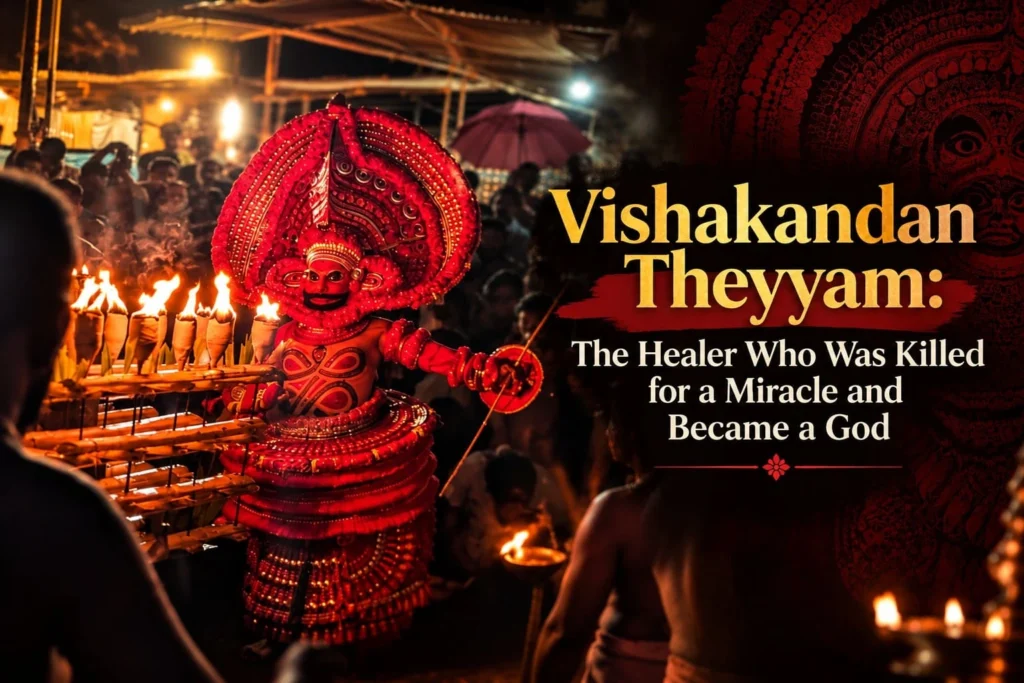
ToggleVishakandan Theyyam is a Kannur ritual deity that honors Kandan, a lower-caste toddy tapper who mastered poison medicine, revived a woman declared dead by upper-caste physicians, and was murdered out of professional jealousy. He is worshipped today at the Kolachery Sree Chathampalli Vishakandan Kavu near Thaliparamba, and his annual performance on Thulam 10, around October 27, traditionally opens the entire North Kerala Theyyam season.
Unlike deities born from myth, Vishakandan comes from documented social history caste injustice, forbidden knowledge, and a killing that local memory refused to let go unanswered. This guide covers his full story, the temple, the exact rituals, and how he fits into Kerala’s wider Theyyam tradition.
Who Was Kandan Before He Became a God?
Kandan was born to Chirakkuni Kunjambu, a toddy tapper of the Thiyya community, in a place called Kulacheri near Thaliparamba, Kannur. Lower-caste children had no right to formal education in that era, so Kunjambu initially forced Kandan into the family’s toddy-tapping trade. But he was moved by his son’s obvious suffering, and he eventually pleaded with local gurus to let Kandan sit and listen to their teachings, since he could not be formally enrolled.
Through sheer persistence, Kandan absorbed the four Vedas, the Vedantas, and the six classical sciences. He went on to master Visha Vaidyam, the science of poison and antidotes, along with the esoteric arts of Indrajalam and Mahendrajalam, and in total some sixty-eight arts and sixty-four vidyas. Despite this scholarship, caste rules of the time barred him from practicing any profession linked to his learning. Kandan returned home and resumed toddy tapping — until one emergency changed everything.
What Is the Vishakandan Theyyam Story?
The core story: Kandan revived a pregnant woman declared dead of snakebite by an upper-caste physician, then was murdered for it by the physician’s family.
A pregnant woman named Nani, of the Kutiatur Kovoor Chathothu family, was bitten by a snake. Her brothers rushed her to the Karumarath family, Namboothiri physicians famed locally for poison treatment — some regional sources record this family as Kumarathilathu Namboothiri, and both spellings appear in North Malabar oral accounts. The Karumarath physician examined her and declared her dead, and because the family’s word on poison cases was considered final, Nani’s brothers began carrying her body home for cremation.
On the way, one of Kandan’s own gurus intercepted them and insisted they show the body to Kandan first. Kandan instructed the brothers to place Nani’s body in the Vengapata pond, then climbed a nearby coconut tree and applied a technique called Kula Karuthu Vidya. When the pond water bubbled, it was the signal to pull her out. He washed her face with pond water, applied leaves from a nearby plant, and the poison left her body — Nani revived completely. Kandan also predicted that she would deliver a son on the fourth day, marked by a blue birthmark on his right thigh, a prophecy that came true exactly as told.
Why Was Kandan Killed?
Kandan was murdered by the Karumarath family out of professional jealousy after he publicly outperformed their hereditary status as the region’s poison physicians.
Word of the miracle spread fast. Villagers showered Kandan with gifts, which he refused, until the grateful Chathoth family built him a house near Vengapata pond and convinced him to accept it. This is where the story turns tragic. The Karumarath family, whose reputation as hereditary poison healers had just been publicly overturned, grew consumed with resentment.
On the ninth day of the Malayalam month of Thulam, only the third night in his new house, three men arrived claiming a woman needed urgent snakebite treatment. Kandan’s wife had dreamed of these men and begged him not to go, but bound by duty, Kandan went anyway. He was murdered that night, and his body, head severed, was found the next morning in a coconut grove. The village understood immediately who was responsible.
What Happened After Kandan’s Death?
The Karumarath family was struck by disaster and forced by an astrologer’s verdict to build a shrine for Kandan, who they were told had become a god.
Their triumph was short-lived. The family began experiencing calamity — dreams filled with snakes overrunning their bodies and home, and a complete loss of peace. Seeking answers, they consulted an astrologer from Payyannur, who delivered the verdict that Kandan had become a divine being, and that without ritual remedy, greater disaster awaited. That remedy became the Kolacheri Chattoth Vishakandan Kavu, the shrine still standing today. Kandan’s story was later formalized as a Theyyam performance under the name Vishakandan.
When and Where Is Vishakandan Theyyam Performed?
Vishakandan Theyyam is performed once a year, before dawn on Thulam 10, around October 27, exclusively at Kolachery Sree Chathampalli Vishakandan Temple near Thaliparamba, Kannur.
The performance takes place in the early morning hours, around 4:00 AM, as the centerpiece of a two-day festival spanning Thulam 9 and Thulam 10. It is performed by artists of the Peruvannan caste, and the same kavu also hosts Thai Paradevatha, Ilamkolam, Elladathu Bhagavathy, and Gulikan theyyams across the festival. The main offerings at the shrine are chicken eggs and coconut oil.
This temple’s festival date matters beyond the shrine itself: Kandan’s death and the founding of his kavu are locally remembered as the marker that opens the entire North Kerala Theyyam season each year. If you’re timing a first visit, pair this reading with our complete Theyyam season guide before you plan travel.
What Rituals Happen During Vishakandan Kaliyattam?
The Vishakandan festival includes a purification ritual by the Karumarath family and a ceremonial re-telling of the betrayal at their household.
Two customs distinguish this Theyyam from most others in Kerala. On Thulam 9, descendants of the Karumarath family visit Chattothu temple to perform pooja and purification rites, a ritual act connected to their ancestors’ role in Kandan’s death. On Thulam 10, the Vishakandan Theyyam performer travels to the Karumarath family home and ritually recounts the story of how Kandan was tricked and killed, a direct, in-character retelling delivered at the site linked to the killing.
This is what sets Vishakandan apart from theyyams built purely on myth: the ritual doesn’t just narrate the injustice, it re-enacts accountability for it, year after year, at the actual family implicated in the story.
How Is Vishakandan Different from Other Theyyams?
Vishakandan belongs to the category of Theyyams honoring real humans killed unjustly, unlike Theyyams built from Puranic myth or animal-deity legends.
Theyyam scholarship broadly groups deities into a handful of origin categories: wronged humans, mother goddesses, animal forms, and Puranic figures. Vishakandan sits firmly in the first group, alongside figures like Kandanar Kelan, whose story is also a wronged local hero deified after death. That’s a different lineage from Puranic Theyyams such as Vishnumoorthi, where a devotee is protected by Vishnu’s Narasimha form, or the mother-goddess tradition behind Chamundi, built around fierce feminine divine power, and it’s equally distinct from a Brahminical, mythic figure like Kuttichathan, worshipped as a playful, mischievous child-deity. Theyyams like Vishakandan and Pottan function as Kerala’s oral record of caste violence and the reversal of power it imagines through divinity.
What Can Visitors Expect at Kolachery Sree Chathampalli Vishakandan Temple?
Visitors should expect a small, privately maintained family shrine with a square sanctum, a pre-dawn performance, and a two-day festival window rather than a large public event.
The shrine is a chathura sreekovil, a square sanctum, with a decorated, traditionally motif-carved roof, and it is privately maintained by the family lineage connected to its founding. Some deities here are worshipped on open platforms and under trees rather than inside an enclosed structure, which is typical of North Malabar kavus. Because the main Vishakandan performance happens around 4 AM, plan to arrive at Kolachery, near Thaliparamba, the evening before. The kavu is small and community-run, so approach it respectfully, as you would any active family shrine, not a tourist site.
For general etiquette, timing, and what to expect at a night-time performance anywhere in North Kerala, see our guide on watching Theyyam at night. If this is your first Theyyam season, start with our full list of Theyyam types to understand where Vishakandan fits into the wider tradition.
Frequently Asked Questions About Vishakandan Theyyam
What does the name Vishakandan mean?
Vishakandan combines “Visha,” meaning poison, with Kandan’s own name, referring to his mastery of poison treatment and antidotes, the skill that both made him a healer and led to his death.
Who performs Vishakandan Theyyam?
Vishakandan Theyyam is traditionally performed by artists from the Peruvannan caste, a community associated with several ritual performance roles in North Kerala’s Theyyam tradition.
Where exactly is Vishakandan Theyyam performed?
It is performed at a single sacred site, the Kolachery Sree Chathampalli Vishakandan Kavu, near Thaliparamba in Kannur district, Kerala.
When does Vishakandan Theyyam take place?
The main performance happens on Thulam 10 of the Malayalam calendar, roughly corresponding to October 27, in the early morning hours around 4 AM, as part of a two-day festival that begins on Thulam 9.
Why does the Karumarath family visit the temple every year?
Local tradition holds their ancestors responsible for Kandan’s death, and the annual visit and purification ritual are understood locally as an act of atonement tied to that history.
Is Vishakandan Theyyam connected to the start of Theyyam season?
Locally, yes. Kandan’s death date and the temple’s founding are remembered as marking the opening of the North Kerala Theyyam season each year.
Key Takeaway
Vishakandan Theyyam is one of the clearest examples in the Theyyam tradition of how Kerala’s ritual culture converts real caste injustice into divine memory. Kandan was a lower-caste healer killed for outperforming his social superiors, and the Theyyam built around him doesn’t soften that history. It re-enacts it, every year, at the very household implicated in his death. That makes Vishakandan Theyyam not just a performance, but a living record of accountability rare even within Kerala’s rich Theyyam repertoire.