Table of Contents
ToggleYour mind feels loud. You sit down, close your eyes, and within ten seconds you’re thinking about tomorrow’s to-do list. This happens to every single beginner — and it doesn’t mean you’re failing.
Direct answer: To meditate as a beginner, sit in a comfortable position, close your eyes, and focus your attention on your breath. When your mind wanders, gently bring it back to your breathing. Start with just 5 minutes a day. That’s it. Everything else is refinement.
This guide walks you through exactly how to start, how long to practice, what posture to use, and how to handle a busy mind. By the end, you’ll have a simple daily routine you can actually stick with.
What Is Meditation, Really?
Meditation is the practice of training your attention on purpose. Instead of letting your mind jump from thought to thought, you choose one point of focus — usually your breath — and keep returning to it.
It is not about stopping your thoughts. No one can do that. It’s about noticing when your mind has wandered and gently coming back, over and over. Each time you do that, you’re building a mental muscle.
Meditation began thousands of years ago in Eastern spiritual traditions, particularly within Buddhism and Indian yogic practice. Today it’s used both as a spiritual path and as a secular tool for calm — you don’t need any religious belief for it to work.
How Do I Sit for Meditation as a Beginner?
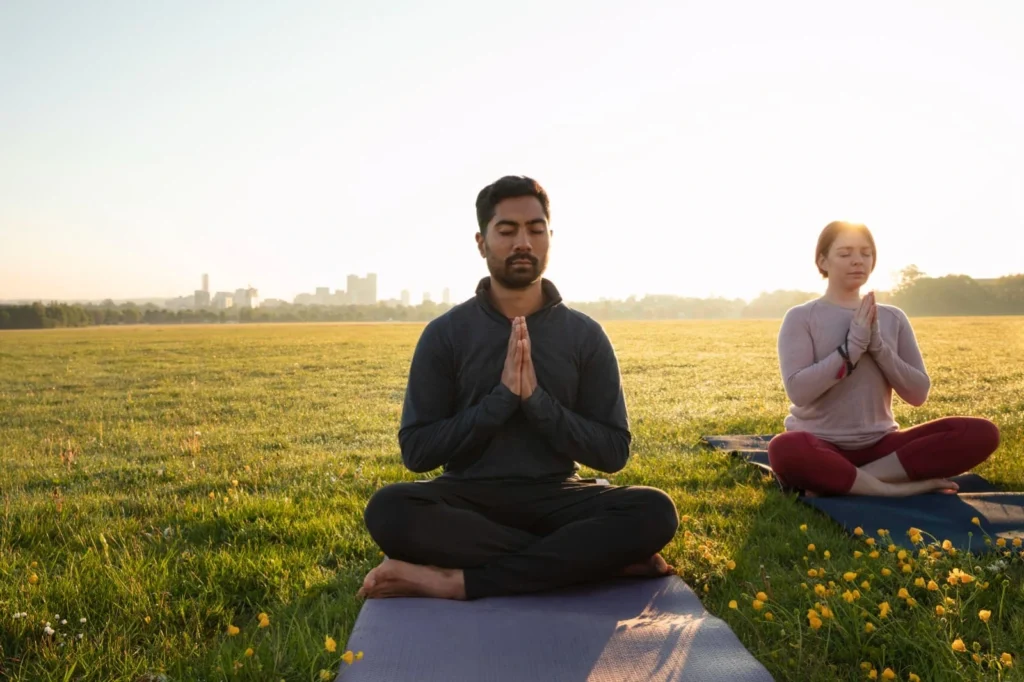
You don’t need a special cushion or a perfect cross-legged pose to meditate. Any position where you’re alert but relaxed will work.
- Sitting on a chair: Feet flat on the floor, back straight but not stiff, hands resting on your knees or lap.
- Sitting on the floor: Cross-legged, with a cushion under your hips if your knees are higher than your hips.
- Lying down: Fine for beginners or for sleep-focused practice, though you’re more likely to doze off.
The main rule: keep your spine reasonably upright if you can. A slouched posture makes it easier to fall asleep or lose focus. Rest your hands wherever feels natural, and let your shoulders drop away from your ears.
What Do I Actually Do Once I’m Sitting?
Once you’re settled, the simplest beginner technique is breath-focused meditation. Here’s the step-by-step:
- Close your eyes or soften your gaze downward.
- Take three slow, deep breaths to settle in.
- Let your breathing return to normal — don’t force it.
- Focus your attention on the physical feeling of breathing: air moving in and out of your nostrils, or your belly rising and falling.
- When you notice your mind has wandered (it will, constantly), simply note “thinking” and gently return your focus to the breath.
- Repeat step 5 as many times as needed until your timer ends.
That last step is the entire practice. Wandering and returning is meditation — it isn’t a sign you’re doing it wrong.
If sitting in silence feels too hard at first, try a guided meditation app or audio track. Following a voice gives your mind something structured to hold onto while you build the habit.
How Long Should a Beginner Meditate?
Start with 5 minutes a day. Consistency matters far more than duration when you’re beginning.
| Week | Suggested length | Focus |
|---|---|---|
| Week 1–2 | 5 minutes | Building the daily habit |
| Week 3–4 | 10 minutes | Getting comfortable with a wandering mind |
| Month 2+ | 15–20 minutes | Deepening focus and awareness |
According to Harvard Health, research led by neuroscientist Sara Lazar found that participants who meditated an average of 27 minutes a day for eight weeks showed measurable increases in gray matter density in brain regions linked to memory and self-awareness. You don’t need to start there — but it shows the practice scales well as you build the habit.
A short daily session beats one long, inconsistent one. Five focused minutes every day will get you further in a month than one 45-minute session you never repeat.
What Is the Best Time of Day to Meditate?
Morning, right after waking, tends to work best for most beginners — your mind is less cluttered and you’re less likely to skip it later.
That said, the “best” time is really the time you’ll actually keep. Consider these options:
- Morning: Before checking your phone, while the house is quiet.
- Midday: As a reset between work tasks or before lunch.
- Evening: To unwind before bed, though this can make some people sleepy.
Pick one slot and attach it to an existing habit — right after you brush your teeth, or right before your morning tea. This “habit stacking” makes it far more likely to stick.
What Should I Do When My Mind Keeps Wandering?
Expect it — a wandering mind isn’t a problem to fix, it’s the normal texture of meditation. Every time you notice you’ve drifted, that moment of noticing is itself the practice working.
Some practical fixes if your mind feels especially busy:
- Count each breath silently up to 10, then start again at 1.
- Label the thought quietly (“planning,” “worrying,” “remembering”) before letting it go.
- Shorten your session — 3 focused minutes beats 15 frustrated ones.
- Try a body scan instead of breath focus if sitting still feels agitating.
According to the National Center for Complementary and Integrative Health (NCCIH), part of the U.S. National Institutes of Health, mindfulness-based practices involve keeping attention on the present moment without judgment — the “without judgment” part is what stops a wandering mind from becoming a source of frustration.
Does Meditation Actually Work? What the Research Shows
Yes — for stress, anxiety, and mild depression, meditation has real, measurable, science-backed effects, though it isn’t a cure-all or a replacement for medical treatment.
In our review of the current clinical research for this guide, three findings stand out:
- A 2018 NCCIH-supported analysis of 142 study groups, covering more than 12,000 participants, found that mindfulness-based approaches performed better than no treatment for anxiety and depression, and worked about as well as established therapies like cognitive behavioral therapy (NCCIH).
- A 2014 review published in JAMA Internal Medicine found meditation helped relieve anxiety, pain, and depression — for depression specifically, it worked about as well as an antidepressant.
- Harvard-affiliated researchers at Massachusetts General Hospital used MRI scans to show that an eight-week mindfulness program increased gray matter density in brain regions tied to memory, self-awareness, and compassion, while decreasing density in the amygdala — the brain’s stress and fear center.
The NHS’s Every Mind Matters guidance echoes this: meditation is a legitimate, low-risk tool for everyday stress management, best used alongside — not instead of — professional care if you’re dealing with a diagnosed condition.
Beyond the Basics: Where to Go Next
Once breath-focused meditation feels familiar, you can branch into specific traditions and techniques, each suited to different goals:
- If you’re drawn to a structured, insight-based practice rooted in Buddhist tradition, explore Vipassana Meditation.
- If you want a practice built around present-moment awareness without a technique-heavy structure, read about Right Mindfulness.
- If breath and body-energy work interests you, look into Kriya Yoga.
- If you want to explore the mind-body-energy centers used in Indian tantric tradition, try Chakra Meditation.
- If stress and anxiety relief is your main goal, our guide on Buddhist Meditation for coping with overthinking is a natural next stop.
- If you want a more contemplative, inward-focused path, see Raja Yoga Meditation.
Frequently Asked Questions
How long should a beginner meditate each day?
Start with 5 minutes a day and build gradually. Consistency matters more than length — a daily 5-minute habit will help you more than one long session per week.
What is the best time of day to meditate?
Morning works well for most beginners because the mind is less cluttered. The best time is ultimately whichever slot you’ll actually repeat every day.
Can you meditate lying down?
Yes, though sitting upright is generally better for staying alert. Lying down is fine for beginners, body-scan practices, or sleep-focused meditation.
Do I need to stop all my thoughts to meditate correctly?
No. Meditation isn’t about having no thoughts — it’s about noticing when your mind wanders and gently returning your focus. That noticing is the practice itself.
Is meditation religious, or can anyone do it?
Meditation has deep roots in Buddhist and yogic tradition, but you don’t need any religious belief for it to work. It’s used today both as a spiritual practice and as a secular tool for calm and focus.
The Takeaway
Meditation for beginners comes down to one habit: sit, focus on your breath, and gently return your attention every time it wanders. Five minutes a day, done consistently, will teach you more than any perfect hour-long session.
Start today. Set a timer for 5 minutes, sit comfortably, and simply follow your breath — and when you’re ready to go deeper, explore Vipassana, Right Mindfulness, or Chakra Meditation to find the path that fits you.