Most people think of yoga as a mat, a pose, and a stretch. But long before Downward Dog became an Instagram staple, yoga was a spiritual roadmap — and it had four distinct routes, not one.
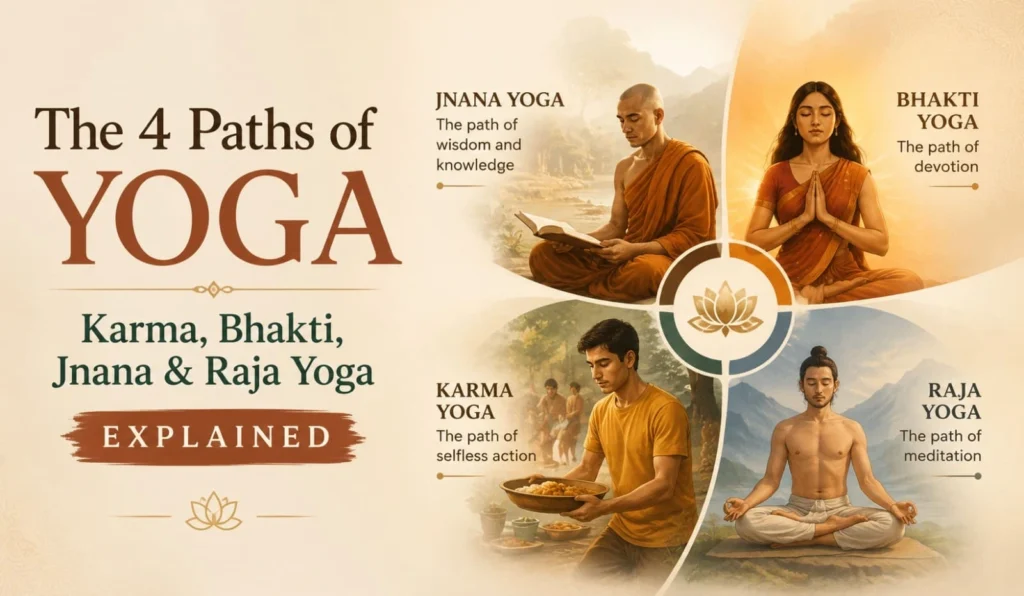
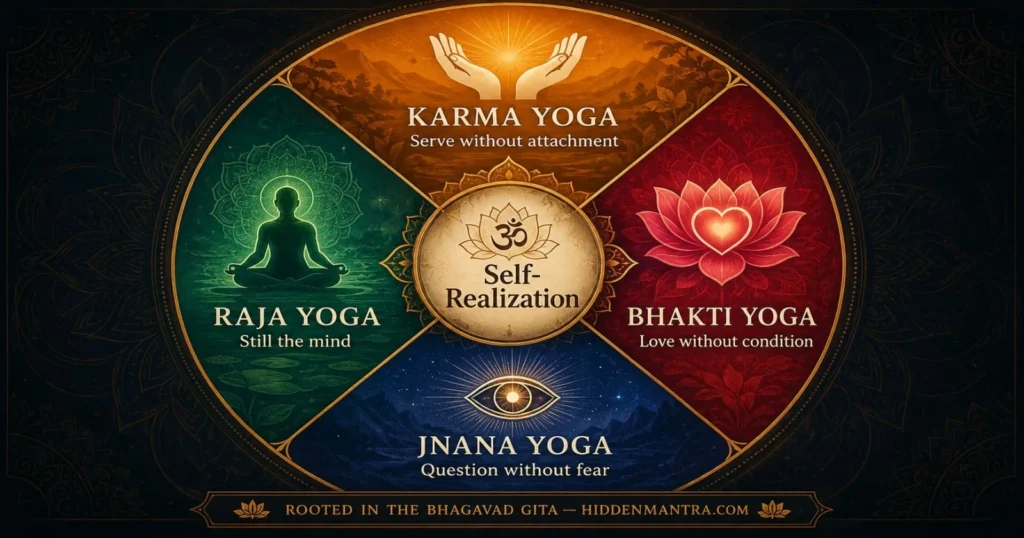
The four paths of yoga are Karma Yoga (the path of action), Bhakti Yoga (the path of devotion), Jnana Yoga (the path of knowledge), and Raja Yoga (the path of meditation). Rooted in the Bhagavad Gita, each path leads to the same destination — self-realization and union with the divine — but through a different door suited to a different temperament.
This guide breaks down what each path actually means, how it’s practiced, and how to figure out which one fits you.
Where the Four Paths Come From
The four paths (chatur yoga marga) trace back to the Bhagavad Gita, the dialogue between the warrior Arjuna and Krishna on the battlefield of Kurukshetra. (For the source verses behind each path, see our Bhagavad Gita quotes in English.) Arjuna is paralyzed by doubt before battle, and Krishna’s response becomes a complete philosophy of how a person can live and still reach liberation — whether through action, devotion, knowledge, or meditation.
Later teachers, especially Swami Vivekananda, popularized the four-path framework in the West in the late 1800s, presenting it as a flexible system rather than four separate religions. Swami Sivananda later called the blend of all four the “Yoga of Synthesis” — the idea that most people don’t walk one path in isolation, but combine elements of all four.
It’s worth noting: this framework of the four paths is philosophical, not physical. It’s a different lens than the “styles” of yoga you see in a studio schedule (Hatha, Vinyasa, Ashtanga, Yin). Those are variations of asana practice — physical postures — which mostly fall under the umbrella of Raja Yoga. If you’re looking for that comparison instead, see our guide on types of yoga styles.
The 4 Paths of Yoga at a Glance
| Path | Sanskrit Meaning | Core Focus | Best Suited For | Key Practices |
| Karma Yoga | Path of Action | Selfless service without attachment to results | People who are active, duty-driven, and community-minded | Seva (service), volunteering, working without expecting reward |
| Bhakti Yoga | Path of Devotion | Love and surrender to the divine | People who are emotional, expressive, heart-led | Kirtan, chanting, prayer, puja, japa (mantra repetition) |
| Jnana Yoga | Path of Knowledge | Self-inquiry and discernment between real and unreal | People who are intellectual, analytical, questioning | Atma Vichara (“Who am I?”), scriptural study, contemplation |
| Raja Yoga | Path of Meditation | Control of the mind through discipline | People who want structure, method, and stillness | Ashtanga’s eight limbs, meditation, pranayama, ethical discipline |
Karma Yoga: The Path of Selfless Action
Karma Yoga is the practice of acting fully while releasing your grip on the outcome. The Bhagavad Gita puts it directly (BG 2.47 karmaṇy-evādhikāras te mā phaleṣu kadācana) : you have a right to your actions, never to the fruits of those actions.
This isn’t passivity. A Karma Yogi works hard — often harder than most — but does the work as an offering rather than a transaction. Over time, this dissolves the ego’s need for credit, recognition, or reward, and the practitioner starts to feel a sense of oneness with whoever or whatever they’re serving.
How it’s practiced:
- Volunteering or service (seva) done without expecting praise or return
- Doing your job or daily duties with full effort but no attachment to results
- Treating ordinary tasks — cooking, cleaning, caregiving — as spiritual practice
Who it suits: People who find meaning through doing rather than sitting still. If your instinct in a crisis is to act, not analyze or pray, Karma Yoga will likely feel the most natural.
For a full breakdown of how the Bhagavad Gita teaches this path, see our dedicated guide: Karma Yoga in Bhagavad Gita.
Bhakti Yoga: The Path of Devotion
Bhakti Yoga channels every emotion — love, longing, grief, joy — toward the divine instead of scattering it across worldly attachments. It’s often called the easiest of the four paths because it doesn’t require intellectual rigor or physical discipline; it asks only for an open heart.
The Vishnu Purana lists nine classical forms of bhakti, including shravana (listening to stories of the divine), kirtana (singing devotional songs), smarana (remembrance), and atma-nivedana (complete surrender of the self).
How it’s practiced:
- Kirtan and chanting (call-and-response devotional singing)
- Japa — repeating a mantra with focused devotion
- Puja (ritual worship) and visiting sacred sites
- Reading and reciting stories of saints and deities
Who it suits: People who are naturally emotional, expressive, or relational — those who process life through the heart rather than the head.
Explore this path in more depth in our guide: Importance of Bhakti Yoga & the Power of Devotion.
Jnana Yoga: The Path of Knowledge
Jnana Yoga is widely considered the most demanding of the four paths. It uses the intellect itself as the tool for transcending the intellect — relentless self-inquiry until every false identity (I am my body, I am my job, I am my thoughts) falls away, leaving only awareness of the Self (Atman) and its unity with ultimate reality (Brahman).
Its central practice is Atma Vichara — the question “Who am I?” — asked again and again, not to be answered intellectually, but to dissolve the one asking it.
How it’s practiced:
- Self-inquiry (Atma Vichara)
- Study of scripture — the Upanishads, Yoga Sutras, Bhagavad Gita
- Viveka — the discipline of discerning the permanent from the temporary
- Renunciation of attachment to material identity
Who it suits: People who are naturally curious, analytical, and unwilling to accept ideas on faith alone. We’ve covered this path in depth in our dedicated guide: What Is Jnana Yoga? How to Practice.
Raja Yoga: The Path of Meditation
Raja Yoga — “royal” or “kingly” yoga — is the systematic, step-by-step path of mastering the mind. This is the path formally codified by Sage Patanjali in the Yoga Sutras (compiled around 400 CE), through the eight limbs of yoga (Ashtanga):
- Yama — ethical restraints (non-violence, truthfulness, non-stealing)
- Niyama — personal observances (cleanliness, contentment, discipline)
- Asana — physical posture
- Pranayama — breath control
- Pratyahara — withdrawal of the senses
- Dharana — concentration
- Dhyana — meditation
- Samadhi — absorption / union
Most modern yoga classes — the ones built around asana and breathwork — are technically a doorway into Raja Yoga, even if the deeper seven limbs are never mentioned. If you want the physical foundation of this path explained in detail, read our guide on Yoga Asana: Meaning, Types & Benefits.
Who it suits: People who thrive with structure, discipline, and a clear method — those who want a defined system rather than an emotional or intellectual approach.
For the full picture, including its history and benefits, read our guide: Raja Yoga Meditation: Unfolding Inner Peace.
How to Know Which Path Is Right for You
You don’t need to formally choose. Most teachers — Vivekananda and Sivananda included — taught that the four paths are not competing religions but four strands of the same rope, and most practitioners naturally blend them. That said, a rough self-check:
- You feel most alive when helping others → start with Karma Yoga
- You feel most alive when your heart is moved → start with Bhakti Yoga
- You feel most alive when you’re questioning and understanding → start with Jnana Yoga
- You feel most alive with routine, discipline, and stillness → start with Raja Yoga
There’s no ranking of “better” or “worse” among the four. The right path is simply the one that keeps you practicing consistently.
Can You Practice More Than One Path at Once?
Yes and most people do, whether they realize it or not. Swami Sivananda called this the Yoga of Synthesis: Karma Yoga purifies the heart, Bhakti Yoga fulfills Karma Yoga, Raja Yoga builds on both, and Jnana Yoga is the fulfillment of all three combined. In practice, this might look like volunteering at a temple (Karma), chanting before you leave (Bhakti), sitting for meditation afterward (Raja), and reading a verse of the Gita before bed (Jnana) — all in the same day.
Frequently Asked Questions
What are the 4 paths of yoga?
The four paths of yoga are Karma Yoga (selfless action), Bhakti Yoga (devotion), Jnana Yoga (knowledge and self-inquiry), and Raja Yoga (meditation and mental discipline). They come from the Bhagavad Gita and offer four different routes to the same goal: self-realization.
Which path of yoga is the easiest?
Bhakti Yoga is generally considered the most accessible, since it requires only devotion and an open heart rather than intense intellectual effort or years of disciplined practice.
Which path of yoga is the hardest?
Jnana Yoga is traditionally considered the most difficult, as it demands sustained intellectual discipline and the ability to question one’s own sense of self without wavering.
Is Raja Yoga the same as the yoga practiced in gyms and studios?
Not exactly. Studio yoga classes usually focus on asana (posture) and pranayama (breath), which are two of the eight limbs of Raja Yoga. The full path also includes ethical discipline, sense withdrawal, concentration, meditation, and absorption.
Do I have to pick only one path?
No. Most spiritual teachers, including Swami Sivananda, taught that the four paths naturally overlap and reinforce each other. You can practice more than one simultaneously based on what each day or season of life calls for.
Are the four paths of yoga specific to Hinduism?
Yes, the four-path framework originates in Hindu philosophy, specifically the Bhagavad Gita. However, the underlying practices — selfless service, devotion, self-inquiry, and meditation — appear in some form across many spiritual and wisdom traditions.