The journey to witness man becoming God began at 4:30 in the morning. Kannur was still dark and silent, and we were heading to Palayi Sree Porkali Bhagavathy Kaavu. I had come as a photographer, chasing the perfect frame – the fire, the costume, the moment the light hits the headgear just right. The guide who drove didn’t talk much, and I was deeply engrossed in my thoughts. Forty-five minutes later, we turned off the road onto something narrower, and the echoes of drums and beats drifted closer.
I could see the torches that came through the dark, and the crowd, along with the powerful smell of oils and something I couldn’t name. Before coming there, I had read about it, but the moment I stood there in the air of a north Kerala village, I was blank, and I watched everything as a curious child.
The Hours Before It Begins
I reached the Kavu a little before 5.15 am. The scheduled start for Kandakarnan Theyyam was 5.45 am, which meant, by the logic of most performances I’d attended in my life, that I had perhaps thirty minutes to find a spot and orient myself.
What I hadn’t understood yet was that this is not that kind of event.
The shrine ground was already full. People of different ages stood there with different views. Teenagers stood as clusters, having the energy of young people who had been awake all night, whereas elderly men sat on low walls and ground with ease, as they had done this many times and knew exactly how to hold themselves for a long wait. Entire families had arranged themselves on mats – children folded against their mothers, already asleep despite everything, grandparents sitting upright with the patient attention of those who understand that you do not rush toward the sacred.
What struck me first, honestly, was the college students. The number of them. Young people in their twenties, at 5 am, at a village shrine – not dragged here by obligation but present with a quality of attention I hadn’t expected. They weren’t on their phones. They were watching.
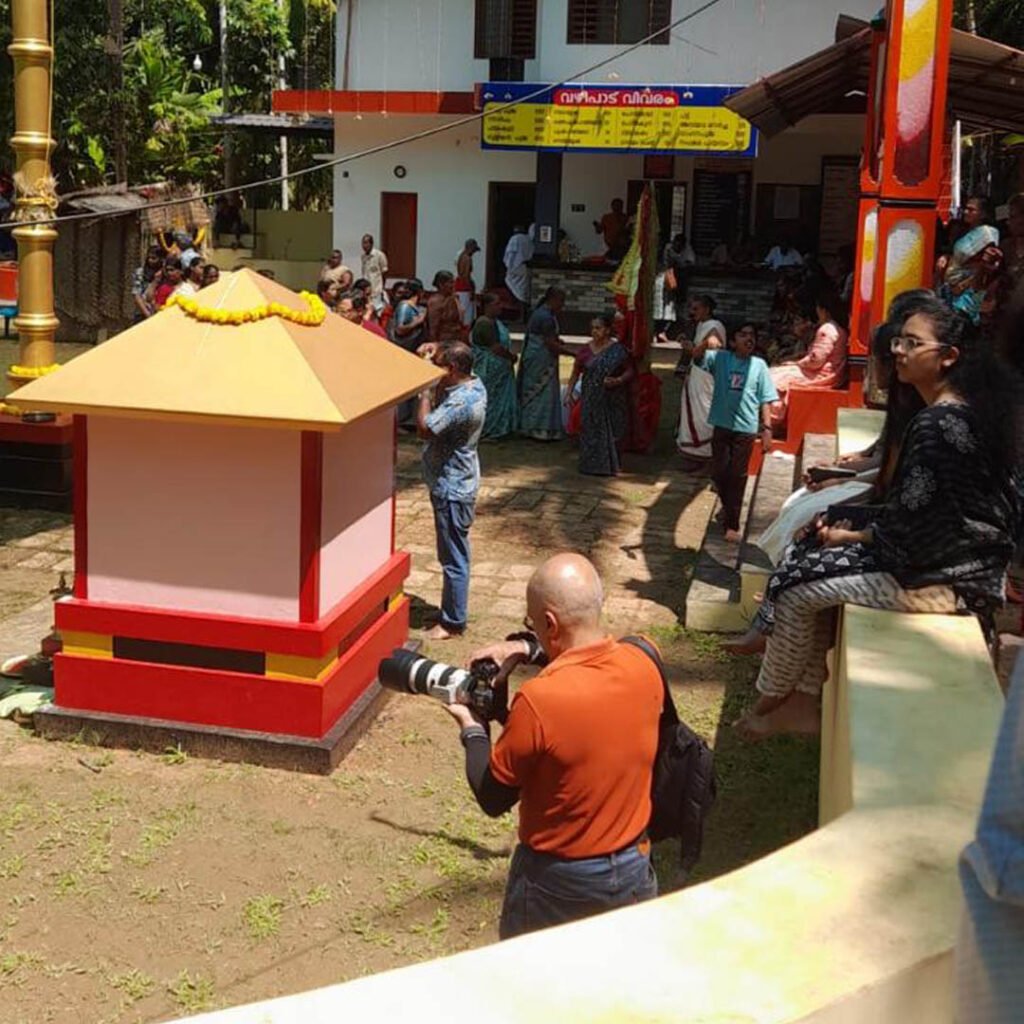
The whole crowd was waiting, waiting for someone very close to all of them, that’s why it didn’t feel long for them, unlike many other art forms it wasnt the audience waiting before curtains for the performance to start, it was something closer to the waiting you do when someone you love is about to arrive – a waiting with direction in it, with relationship in it.
On the other side, I saw a cluster of oil lamps whose flames bent slightly in a breeze I couldn’t feel, but I could move and see what was happening there, so I moved closer
The oil lamps around the shrine’s boundary were small enough that the dark in between felt more complete. The offerings arranged at the threshold -flowers, coconut, the particular shapes of ritual objects I didn’t know the names of -had been there long enough that they had taken on the quality of the shrine itself, as if they had always been there and would always be there.
And now the drumming that had been just warming up now grew slightly more purposeful, not louder; I heard the thalam (beats) getting changed as it conveyed “the arrival of God can happen at any time”
I found a place to stand and stayed there.
The Transformation
While I stood there, I thought about what happens to a performer’s body across those hours of preparation, the process of being a heroic cult, and how mentally and physically ready they should be. To understand, you have to make yourself pay attention with patience.
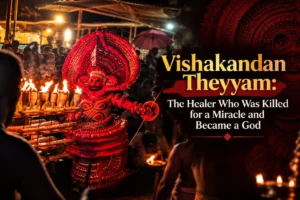
I watched the makeup application from a respectful distance, in a way that I could see the detail. There were rice paste, turmeric, and the red of limestone; these were being applied with an intention that was different from other cosmetics. The red, I would learn later, signals energy and anger, the fierce protective force of the deity being embodied. Watching it applied, slowly, in layers, I understood this intuitively before I had the words for it. The colour wasn’t decorating the man’s face. It was replacing it.
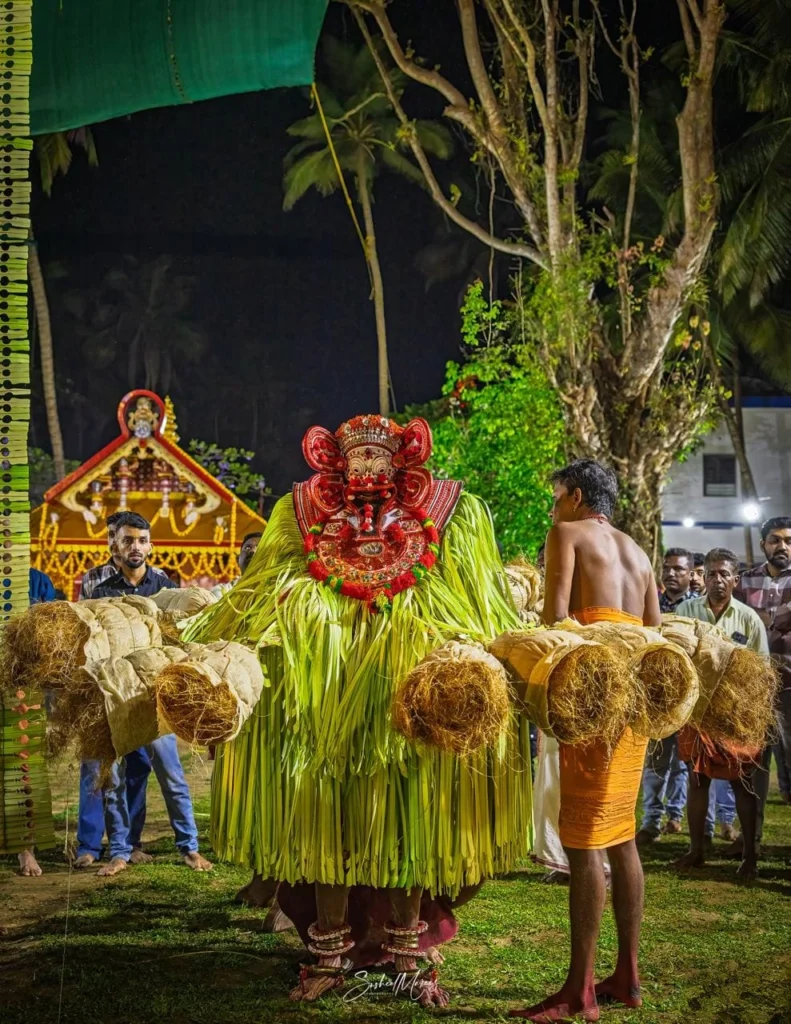
One of the most difficult and lengthy parts I felt was wearing the costume. The headgear called the mudi, is grand and big. It’s built on a bamboo frame, wrapped in woven coconut leaves, draped in red cloth, and decorated with peacock feathers and flowers. Everything is tied down tight. Standing a few metres away, watching it being assembled piece by piece in the torchlight, it looked less like a costume being put on and more like a structure being built around a person.
Just like that, at five in the morning, a man is becoming a deity with lamplight around and drums building around you, making you reach a different level of divinity.
One moment that I kept thinking about is when the performer’s eyes changed. He had been sitting, present and cooperative, as the elaborate work was done around him and on him. And then, at some point during the final stages of preparation, he wasn’t sitting in the same way anymore. His body was the same. The same chair, the same lamplight, the same hands working on the same headdress. But his attention had moved somewhere I couldn’t follow.
The people around me noticed it too. Then the crowd’s watching got shifted, people stood slightly different, and conversations that had been murmuring a few feet away went quiet.
I don’t know what I believe about what I witnessed in that moment. I know what I saw.
What Happens When the Theyyam Arrives
When Kandakarnan entered the space – fully costumed, that massive headgear rising above the torchlight – the people around me didn’t applaud or shout. They moved toward him. Quietly, one by one, each person with something in their hands or their eyes or their posture that said: I came here for this.
An older woman with folded hands. A young man with his head down. A mother steering her child forward by the shoulders.
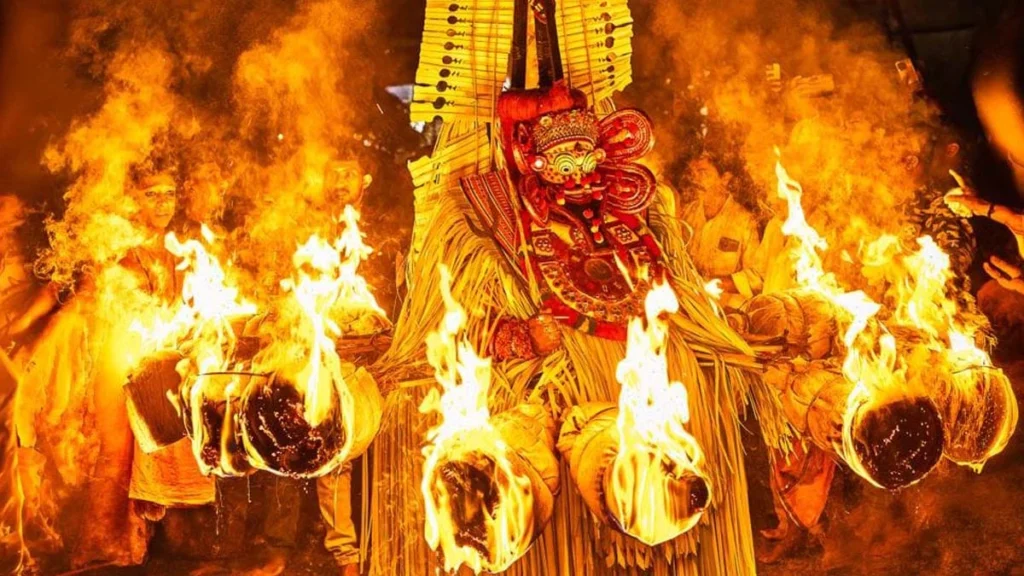
The burning torches built into the headgear threw light that kept shifting, so the whole figure seemed alive in a way that was hard to look away from. When the fire-dancing began, it didn’t feel like a performance. It felt like something being done – the way you do something that needs doing.
Here’s what you need to understand about what you’re watching: Theyyam is not a dancer playing the role of a god. According to the tradition – and to the people who had come from their villages to stand in this kavu at five in the morning – the deity is actually present. With the mental and physical ritual preparations of the performer, it acts as a vessel. At the end, when the headgear is removed in a ceremony called Mudiyeduppu, he returns to being an ordinary man. But until then, something else is happening. That’s what everyone in that crowd believes.
After the fire-dancing, the Theyyam went still. And then people began to approach with their prayers and problems.
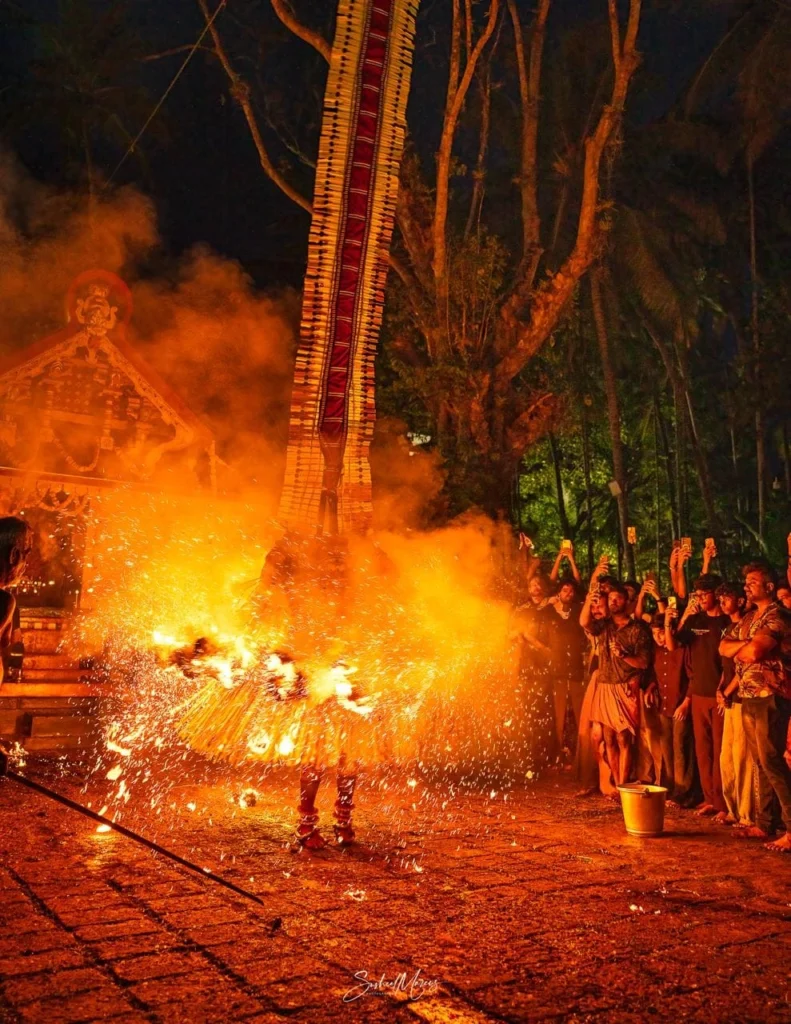
I watched one woman speak to the deity for a few minutes. I couldn’t hear her words. But I could see her face going in, and I could see her face coming out. They were not the same face. I can’t explain it beyond that, because that’s all I know.
I hadn’t expected to feel what I actually felt. I thought I’d be moved in some big, expected way – the way you think you’ll feel before you go to something you’ve been told is special. What actually happened was smaller and stranger than that. I felt like someone who had walked into a room where something real was going on, and wasn’t sure they were supposed to be there. Not unwelcome. Just aware – very suddenly -of how much history there was between these people and this deity I was standing at the edge of and couldn’t enter.
I stayed at the edge. It felt like the right call.
What the Night Does to You
By the time the Theyyam arrived, I had already been awake for hours.
The 4.30 am pickup. The dark drive through Kannur. The long wait at the kavu before anything began. By that point, I’d crossed some line where tiredness stops feeling like tiredness and becomes something else -a kind of clearness, almost. The cold helped. I hadn’t dressed for it, which was a mistake. The air before sunrise in Kannur gets into you. But it kept me sharp.
There’s something that happens when you stand in the dark for a long time with nothing to do but watch. Your mind goes quiet. All the usual stuff – the planning, the checking, the narrating of your own experience – fades out. What’s left is simple: the lamplight, the drums, the smell of camphor and smoke, the way the fire in the headgear throws shadows up instead of down.
In the days after, one thing kept coming back to me. Not the fire-dancing, though that was extraordinary. Not the oracle moment, though that was the strangest thing I’ve seen in years of travel. What I kept thinking about was the face of a college student I’d noticed earlier, one of a group of young guys who’d arrived chatting and laughing. I caught his face during the fire-dancing. It was completely still. Not the look of someone having a big emotional moment. The look of someone who genuinely didn’t know what to think.
I recognised it. It was probably my face too.
The question that stayed with me wasn’t the one I expected. It wasn’t about belief, or about what was really happening up there. It was more personal than that: what else in my life gets that quality of attention from me? What makes me go that still?
Watching Theyyam at night didn’t give me answers. It gave me a better question.
And for what it’s worth — I felt welcome. People noticed me, smiled at me, gave me space. Nobody told me where to stand or explained things I didn’t ask about. The ritual wasn’t for me, and everybody knew it, and that was exactly right. I was a guest at something that has been happening for over a thousand years. The only appropriate response to that is to show up, be quiet, and stay until the end.
I stayed until the end. I’m glad I did.
If You Want to Be There
Theyyam season runs from November to May. The best time to go is December to February- that’s when the most significant performances happen, the nights are at their coldest, and the energy at the shrines is at its highest.
Finding a specific performance as an outsider is harder than it sounds. Venues do publish schedules – date-by-date, time—by—time—but getting to the right kavu, at the right hour, in a village that isn’t on any tourist map, is genuinely difficult without help. This is not a cultural show put on for visitors. There are no signs in English pointing you to the entrance.
The honest advice: go with someone who knows the kavu. It’s the difference between a long night of wrong turns and actually being there for what you came for. The easiest way to attend a real village Theyyam without losing your first night on a Kannur backroad is to go with a guide who has been there before — and Hidden Mantra can take you there.
What to bring:
- A warm layer. Seriously. The pre-dawn cold will find you.
- A torch for navigating in the dark.
- Water, and something to sit on. The waiting is long.
- Cash, if you want to make an offering.
What to wear: modest clothing. Remove your footwear before you enter the shrine enclosure- this is non-negotiable. There’s no official dress code, but the people around you will notice how you’ve chosen to show up.
How to behave: arrive early and find your spot. Don’t cross into restricted areas. Don’t photograph devotees without their awareness. Put your phone on silent and keep it there. This is a village shrine at 5 am, not a content opportunity.
Stay for the whole night if you can. The thing you came for happens in the hours before dawn, and the waiting before it is part of the experience – not the preamble to it.
Conclusion
Somewhere on the drive back, the sky started to go light. Not sunrise yet – just that first grey loosening of the dark. I didn’t say anything and neither did my guide. The drums were still going somewhere behind us, faint now, and then gone.
That sound is what I keep coming back to. The way it reached the car before we could see anything. Before I knew what kind of night it was going to be.If this is something you want to experience, Hidden Mantra can take you there. They arrange real village Theyyam visits in Kannur -guided, respectful, and nothing like a tourist package.
Writen by