Table of Contents
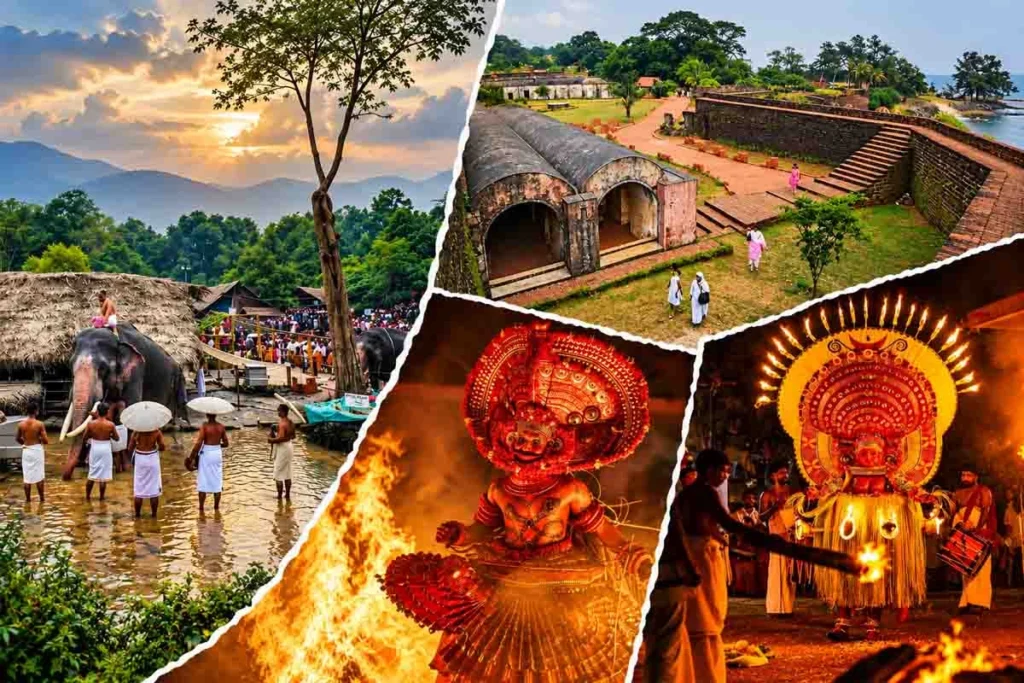
ToggleMost Kerala travel guides send you to Kannur for the beaches. That misses the point. Kannur is where Theyyam — Kerala’s oldest living ritual art form — is still performed nightly in village shrines, where a 500-year-old Portuguese fort sits beside a working fishing harbor, and where temple traditions stretch back centuries with almost no tourist staging.
The best places to visit in Kannur for spiritual and cultural travel are Parassinikadavu (Muthappan Temple and daily Theyyam), Peralassery Sri Subrahmanya Temple, Payyannur Sree Subrahmanya Swami Temple, Sri Rajarajeswara Temple at Taliparamba, St. Angelo Fort, Arakkal Museum, Mopila Bay, Thalassery’s heritage town, Aralam Wildlife Sanctuary, Paithalmala, Kavvayi Kayal backwaters, and Kannur’s coastline — Muzhappilangad Drive-in Beach, Dharmadam Island, Payyambalam, Kizhunna-Ezhara, Ezhimala, and Meenkunnu.
This guide groups them by what they actually are: living ritual sites, heritage and history, and nature and coastline — so you can build a trip around Kannur’s spiritual character rather than a generic beach hop.
Living Ritual Sites
1. Parassinikadavu: Where Theyyam Happens Almost Every Day
Parassinikadavu, about 17 km from Kannur, centers on the Sree Muthappan Temple on the banks of the Valapattanam River, one of the few places in Kerala where a form of Theyyam ritual is performed almost daily rather than only during festival season.
Muthappan is worshipped through an unusual, informal style of devotion — offerings of toddy and fish are accepted at the shrine, a rarity among Kerala temples. If you’ve read our Theyyam festival guide or explored the different types of Theyyam, this is the easiest place to witness the ritual in person outside the main festival months.
- Best time: early morning or evening for daily rituals
- Etiquette: always ask before photographing performers or devotees — see our guide on watching Theyyam at night for context on what’s appropriate
- Nearby: a reptile conservation park sits within the same complex, home to roughly 150 species
2. Peralassery Sri Subrahmanya Temple: A Village Still Living Its Traditions
Peralassery, about 15 km from Kannur, is a temple village built around the Sri Subrahmanya Temple, one of the well-known shrines of Malabar, with a rural character that has changed little despite tourism growth elsewhere in Kerala.
The village’s hanging bridge and unhurried pace make it a useful stop for understanding how temple life functions outside of festival spectacle.
- Best time: morning rituals, or the Navratri period for larger ceremonies
- What to notice: the temple’s role as a community center, not just a devotional site — this is closer to how most Malabar temples actually function day to day
3. Payyannur Sree Subrahmanya Swami Temple: The “Palani of Kerala”
Payyannur Sree Subrahmanya Swami Temple, about 43 km from Kannur, is regarded as one of the three most important Maha Subrahmanya temples in South India and is commonly called the “Palani of Kerala,” with a two-storied sanctum built in the Gajaprishtam style (shaped like an elephant’s back) housing a 6-foot idol of Lord Subrahmanya.
Tradition holds that the temple was originally consecrated by Parashurama; it was destroyed twice — once by fire and once during Tipu Sultan’s campaigns — before being rebuilt in 1792. Payyannur itself, whose name derives from “Payyan” (an epithet of Subrahmanya) and “ur” (place), was historically the northernmost of Kerala’s 32 ancient Brahmin settlements.
- Best known for: the Pavithra Mothiram, a sacred ring made only to order from gold and holy darbha grass, sanctified at the temple before it’s worn
- Best time: the 14-day annual festival beginning on Vrischika Sankramam (mid-November), known as Samaradhana — notable for having no elephants and no flag-hoisting, unlike most Kerala temple festivals
- Distance: about 43 km from Kannur, roughly 4 km from Kavvayi
4. Sri Rajarajeswara Temple, Taliparamba: One of Malabar’s Great Shiva Temples
Sri Rajarajeswara Temple in Taliparamba, about 23 km from Kannur, is one of the most significant Shiva temples in Kerala’s Malabar region, with centuries of unbroken ritual tradition and architecture typical of the region’s temple-building style.
Photography inside the sanctum is generally restricted, so plan to take in the outer architecture and temple grounds instead of expecting interior access.
- Best time: major Shiva-related festival periods, when the ritual calendar is most active
- Distance: 23 km from Kannur, 20 km from Payyanur
Heritage and History
5. St. Angelo Fort: Malabar’s Colonial Turning Point
St. Angelo Fort is a 16th-century Portuguese sea fort in Kannur city, built in 1505 by Dom Francisco de Almeida, the first Portuguese viceroy of India, and later captured by the Dutch in 1663 — marking the start of European power struggles along the Malabar coast.
The fort’s laterite walls sit on a cliff above the Arabian Sea, about 3 km from Kannur Railway Station, and entry is free.
- Best time: early morning, before crowds arrive
- Context: this is where Kannur’s identity as a trading and spice port begins — worth visiting before the temple sites, to understand what drew outside powers to this coastline in the first place
6. Arakkal Museum: Kerala’s Only Muslim Royal Family
The Arakkal Museum, in Kannur’s Ayyikkara area, occupies the former durbar hall of the Arakkal family — the only Muslim royal dynasty in Kerala’s history — and was converted into a public museum by the Kerala government in 2005.
The Arakkal rulers once controlled parts of the Malabar coast and the Lakshadweep islands, a detail that reshapes the usual narrative of Kerala’s royal history.
- Distance: about 3 km from Kannur Railway Station
- Pair with: St. Angelo Fort and Mopila Bay for a half-day heritage circuit
7. Mopila Bay: The Working Harbor Beside the Fort
Mopila Bay sits beside St. Angelo Fort and is Kannur’s active fishing harbor, built with Indo-Norwegian development assistance, on ground once held by the Kolathiri Rajas before Portuguese arrival.
It’s a working harbor, not a scenic set piece — the value here is in watching how the coastline still functions as a livelihood, not just a heritage backdrop.
- Best time: early morning, when fishing boats return
- Nearby: a five-minute walk from St. Angelo Fort
8. Thalassery: The Heritage Town Behind Kerala’s Cricket and Bakery Culture
Thalassery, about 22 km south of Kannur, is a British-era heritage town centered on Thalassery Fort, widely credited as the birthplace of cricket in Kerala and of the state’s first bakery culture.
Walk the old town for colonial-era buildings and spice markets that trace the same trade routes the Portuguese and Dutch fought over centuries earlier.
- Try: Thalassery biryani, and the town’s original bakeries
- Nearby: Muzhappilangad Beach is about 15 minutes away by road
Nature and Coastline
9. Aralam Wildlife Sanctuary: The Western Ghats Behind the Coast
Aralam Wildlife Sanctuary, about 55 km from Kannur at the foothills of the Western Ghats, protects elephants, gaur, deer, and a range of endemic bird species across evergreen and moist deciduous forest.
It’s a useful reminder that Kannur’s identity isn’t only coastal — the district runs from Arabian Sea shoreline to Western Ghats forest within a single day’s drive.
- Best time: October–March, early morning entry
- Check first: the Kerala Forest Department listing for current seasonal access rules
10. Paithalmala: A Trek to 1,300 Meters
Paithalmala is a trekking destination roughly 1,300 meters above sea level on the Kerala-Karnataka border, reached by a moderate 3–4 hour forest trek with panoramic Western Ghats views from the summit.
Forest checkpost permits are required, and the trek closes during heavy monsoon months.
- Best time: October to February
- Distance: around 65–70 km from Kannur, best as a full day trip
11. Kavvayi Kayal: Malabar’s Own Backwaters
Kavvayi Kayal, about 50 km from Kannur near Payyannur, is the third-largest backwater in Kerala and the largest in North Kerala, formed by the confluence of five rivers — Kavvayi, Kankol, Vannathichal, Kuppithodu, and Kuniyan — across roughly 37 square kilometers of islands, mangroves, and channels.
Historically known as Kavil Pattanam, the area was a working port for the spice and steel trade, mentioned in the travel writings of Ibn Battuta and Marco Polo. Valiyaparamba, its largest island at over 16 square kilometers, gives its name to the northern stretch of the backwaters. Kannur district holds around 80% of Kerala’s mangrove cover, and Kavvayi has some of its most intact patches.
- Best time: October to March, early morning or late evening for boat rides
- What to do: country-boat cruises, kayaking through the mangroves, government ferry rides between islands
- Distance: about 50 km from Kannur, roughly 4 km north of Payyannur
12. Muzhappilangad Drive-in Beach: India’s Only Legal Drive-in Beach
Muzhappilangad Drive-in Beach, about 16 km from Kannur, is India’s only legal drive-in beach and the longest drive-in beach in Asia, with a driveable stretch of roughly 4 kilometers protected by offshore rocks that keep the sand firm.
- Best time: low tide, late afternoon
- Nearby: Dharmadam Island is a short walk away at low tide
13. Dharmadam Island: The Green Island
Dharmadam Island, locally called Pacha Thuruthu, is a small palm-covered island about 100–200 meters off Muzhappilangad Beach that becomes walkable at low tide.
- Best time: check tide tables before visiting — this only works at low tide
- Pair with: Muzhappilangad Beach, a single combined stop
14. Payyambalam Beach: Kannur’s Everyday Sunset Spot
Payyambalam Beach is Kannur city’s main beach, known for its gardens and the “Mother and Child” sculpture by artist Kanayi Kunhiraman, and is the easiest coastal stop to reach without a vehicle.
- Distance: about 2 km from Kannur Railway Station
- Best time: 5–6:30 p.m.
15. Kizhunna-Ezhara Beach: Kannur’s Quiet Twin Beach
Kizhunna and Ezhara are twin beaches about 12 km from Kannur, among the cleanest and least crowded stretches of coastline in the district, backed by laterite cliffs and casuarina groves.
- Best time: late afternoon into sunset
- Activities: swimming, cycling along the shore
16. Ezhimala: Seven Hills with Naval and Royal History
Ezhimala is a coastal hill formation of seven interconnected hills near Kannur, historically the seat of the Mooshika kings and now also home to the Indian Naval Academy.
- Distance: about 35–40 km from Kannur
- Note: parts near the academy have restricted access — check current visitor rules before planning
17. Meenkunnu Beach: The Locals’ Beach at Azhikode
Meenkunnu Beach, about 11 km from Kannur city at Azhikode, is a quieter alternative to Payyambalam, backed by palm groves and known mainly to local families.
- Distance: 11 km from Kannur city
- Best time: late afternoon
Kannur Drive-Time Reference Table
| From Kannur Town | Approx. Distance | Drive Time |
|---|---|---|
| Payyambalam Beach | 2 km | 8 min |
| St. Angelo Fort | 3 km | 10 min |
| Arakkal Museum | 3 km | 10 min |
| Mopila Bay | 3 km | 10 min |
| Meenkunnu Beach | 11 km | 25 min |
| Kizhunna-Ezhara Beach | 12 km | 25 min |
| Peralassery Temple | 15 km | 30 min |
| Muzhappilangad Beach | 16 km | 30 min |
| Dharmadam Island | 16 km | 30 min |
| Parassinikadavu | 17 km | 35 min |
| Thalassery Heritage Town | 22 km | 40 min |
| Sri Rajarajeswara Temple | 23 km | 45 min |
| Ezhimala | 35–40 km | 1 hr |
| Payyannur Subrahmanya Temple | 43 km | 1 hr |
| Aralam Wildlife Sanctuary | 55 km | 1 hr 30 min |
| Kavvayi Kayal | 50 km | 1 hr 10 min |
| Paithalmala | 65–70 km | 2 hr |
Why Kannur Matters for Anyone Interested in Living Tradition
Kerala Tourism describes Kannur as a coastline where colonial-era forts, ritual traditions, and temple worship still coexist without heavy tourist staging. For anyone drawn to Theyyam specifically, Kannur is the only district where you can pair a temple visit with a nightly ritual performance, a centuries-old fort, and untouched backwaters in the same district — a combination that doesn’t exist anywhere else in Kerala.
Final Takeaway
Kannur isn’t a beach detour from the rest of Kerala — it’s where Malabar’s ritual, royal, and colonial histories overlap in a single district. Start with the temple and ritual sites, layer in the forts and heritage towns, spend a slower day on the Kavvayi backwaters, and treat the coastline as what you see between them, not the main event.
Go deeper into Theyyam before you travel: read our complete guide to Theyyam festival traditions, browse the different types of Theyyam, or check Kerala Theyyam tours for planning a trip built specifically around the ritual calendar.