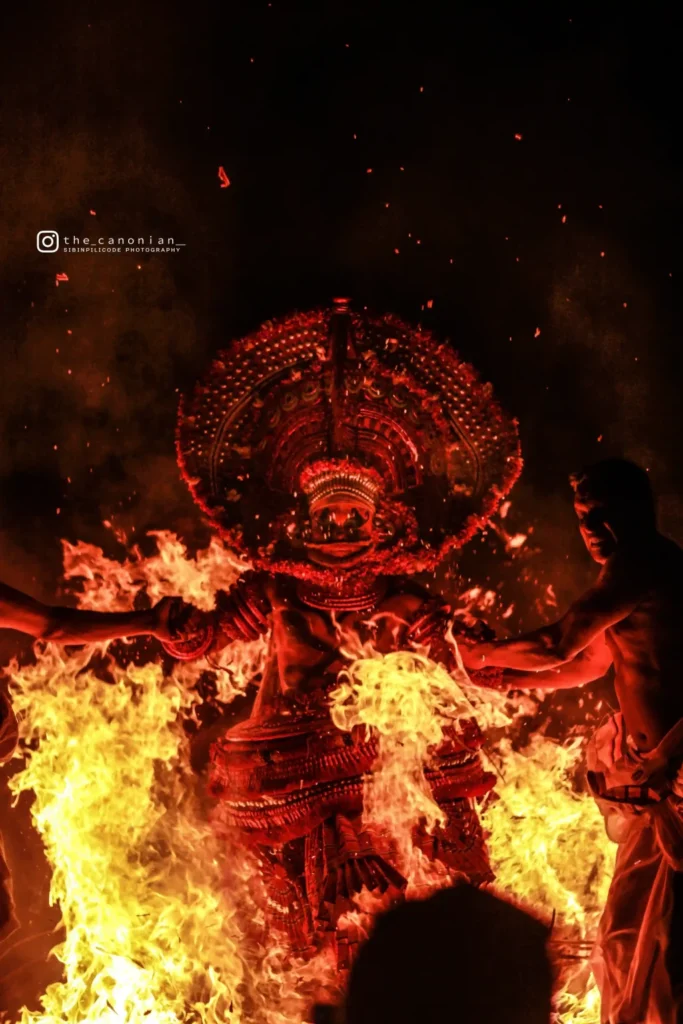
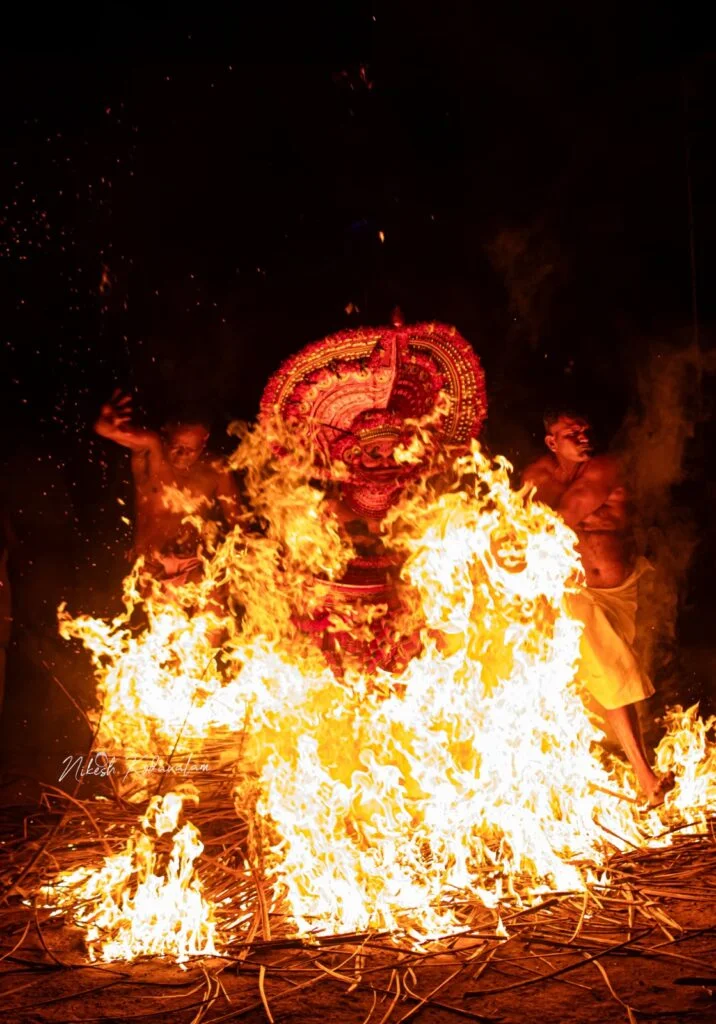
He is the only Theyyam in Kerala who walks through fire wearing silk.
Yes, without any coconut leaves, fireproof clothes. Every other performer who does a fire sequence uses coconut leaves – they char slowly, and they give some protection. Kandanar Kelan refuses. He has always refused. Because the man this Theyyam is built around didn’t get to choose what he was wearing when fire found him. He was just a farmer, doing his work, in his ordinary clothes. And the forest burned around him.
Kandanar Kelan Theyyam is one of the most powerful ritual performances in North Kerala. If you’ve never heard of Theyyam before, here’s the simplest way to understand it: it’s not a dance, it’s not theatre. It’s a performer becoming the deity. The community gathers not to watch someone play a role -they gather because the god has arrived.
This article will give you the full story – who Kelan was, what happened to him, why the silk matters, how the performance actually feels when you’re standing there at 4 am, and how you can go and see it for yourself.
Kandanar Kelan Theyyam Story
My great-grandmother told me this story slowly, pausing to watch my face to see if I understood the right parts. I’ve heard it many times since. It never stops feeling like the first time.
The story starts in a place called Meledath Tharavadu – a respected family home in a village called Kunnaru, near Ramanthali, close to Payyannur in Kannur district. The woman who ran that household was called Chakki Amma.
One day, she brought home a baby boy from a place called Mukkuttikadu. She raised him as her own son. She named him Kelan. Kelan grew up and became a farmer. But not just any farmer -the kind of person who has a real relationship with the land. Every field he touched did well. The crops grew. The soil responded to him. Chakki Amma’s lands flourished because of him.
But she had a dream. She had lands far away in the forests of Wayanad – places called Mukkuttikadu, Moovarkunnu, Nallathenga, Karimbanakkadu – and they were still wild, uncleared, unfarmed. She wanted those lands to be as productive as her lands at home.
She asked Kelan if he would go. He said “yes” with his bow and arrow carried enough for the long journey. Then he walked. Alone, through forests and hills, for days, toward Wayanad. By the time he arrived, he was tired and a little drunk from the toddy — but he was completely determined. He got to work and started clearing the forest, tree by tree. It was hard, physical work, and he did it alone. One tree fell, then another. The clearing grew wider. The forest retreated. He kept going.
Until there was only one tree left, A single gooseberry tree stands in the middle of the cleared ground. He walked toward it, but what he didn’t see and knew was that two nagas lived in that tree named Kali and Karali. They had lived there for generations. They were watching from the branches as Kelan built a fire around the last of the trees to finish the clearing. The fire caught. It spread the way fires do when you’re not expecting them to -faster, wider. It circled back. Kelan realised he couldn’t get out. The flames were on every side.
He climbed the only thing still standing. The gooseberry tree, the nagas, terrified, bit him. Multiple times. Their venom moved fast.
The three of them – Kelan and the two serpents, Kali and Karali – died together in that fire. A man who had walked all that way to do a job. Two serpents who had never left their home. None of them had wanted this.
This is the part my great-grandmother always said quietly.
Not the death. The fact that none of them wanted it.
The warrior god Vayanat Kulavan was passing through that forest. He found Kelan’s body in the burnt clearing. He brought him back to life. He gave him a new name — Kandanar Kelan. He blessed him and made him a companion deity.
And from that day, every performer of this Theyyam carries Kali and Karali painted across his chest. Two serpents, drawn in black and red, crossing the sternum. A permanent record of that moment in the tree.
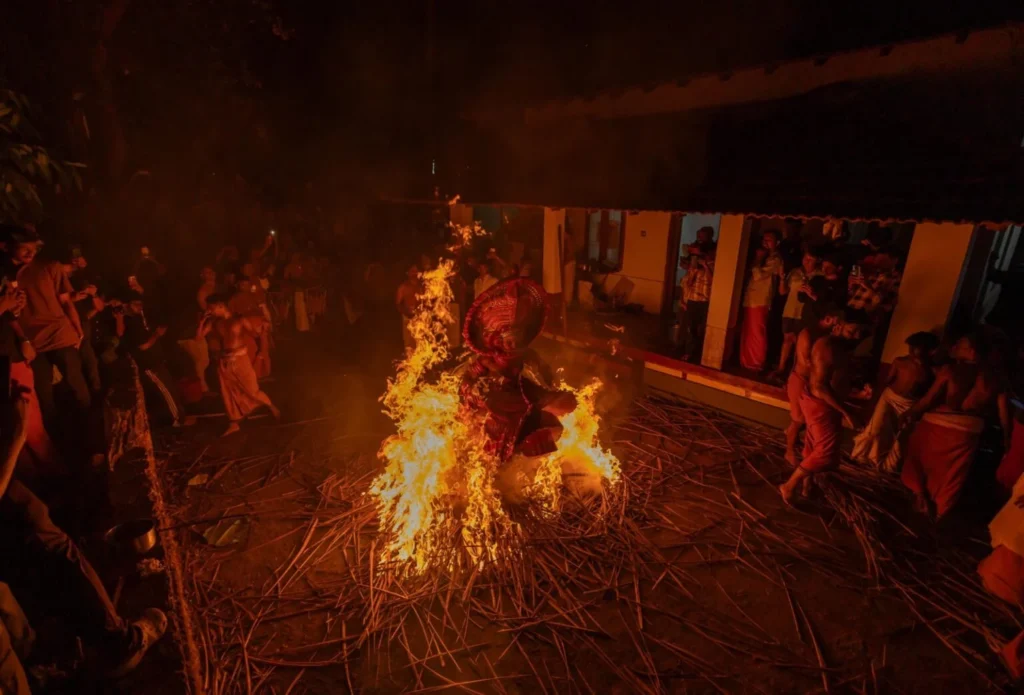
The fire is remembered too. It is performed every time, in silk.
Why Silk. Why Fire. What It Actually Looks Like.
I want to tell you what I saw.
It was Muthachivalappil Tharvadu in Kannur. Past midnight. The performance space had no artificial lights at all – when you first walk in, you’re walking into real darkness, and you find your position by feel more than by sight. There were maybe a hundred people already there. Families sitting on the ground. Old women with their saris pulled around their shoulders against the cold. Kids who had fallen asleep against their mothers and woken up again. A few photographers trying to be invisible. A few travellers who clearly had no idea what was about to happen.
Nobody was talking much. There was just the drums, low and constant, the way a heartbeat sounds when you press your ear to a wall.
Then they lit the fire.
And in that orange flare, I saw him for the first time.
The performer was standing at the edge of the light. He was wearing silk — deep, jewel-coloured, catching the fire in a way that made it look like the fabric was already burning. Across his bare chest, the two serpents. The silver anklets at his feet. The headdress rising above everything.
Every other Theyyam that does a fire sequence uses coconut leaves for the moment of fire. They wrap the performer partly in leaves — it gives some protection, some buffer between the body and the flame. Kandanar Kelan doesn’t. The silk offers nothing. It catches light. In that moment, it looks exactly like what it is: a man walking into fire in his ordinary clothes, the way Kelan did in the forest. No preparation. No protection. Just the memory of a death, performed again.
The drums got louder. The crowd went silent in a way crowds rarely go silent. Not respectful quiet – real quiet, the kind where you can hear the fire.
He moved through it. Slowly. Not fast, not panicked – slowly. He looked straight ahead. The silk caught the light at every step.
From where I was standing, several metres back, I could feel the heat on my face.
I don’t know what passes through a performer’s mind in that moment. Nobody outside that tradition can know. But I know what I felt standing there – that I was watching something true. Not a performance of something. The thing itself.
What is Kandanar Kelan Vellattam?
Most visitors arrive and see the main Theyyam. But the night actually starts much earlier, with something called the Vellattam – and if you’re only watching the Vellattam, you’re seeing something that no travel article properly covers.
The Vellattam is the preliminary ritual. It happens in the hours before the full Theyyam begins – usually around midnight or 1 am. The performer at this stage wears a simpler version of the costume. The great headdress – the Mudi – isn’t in place yet. The face paint is there, the ritual is real, but it’s the deity arriving gradually, not all at once.
What you hear during the Vellattam is the story. The chanting carries the full narrative of Kelan’s life and death — the journey to Wayanad, the clearing of the forest, the gooseberry tree, the nagas, the fire. It’s sung slowly, with the percussion underneath it, and even if you don’t understand Malayalam, the rhythm of it gets into you.
The function of the Vellattam is exactly what it feels like: preparation. The performer is moving toward becoming the deity. The community is moving toward the full arrival. It’s like watching a sky change colour before sunrise — the full event hasn’t happened yet, but something is unmistakably happening.
You can watch the Vellattam as a visitor. Stand at the outer edge of the space. Give the family and devotees the ground closest to the performance. Don’t treat it as a warm-up act, because it isn’t one – it’s a ritual with its own completeness.
The Vannan Community — Who Performs This Theyyam
Kandanar Kelan Theyyam belongs to the Vannan community. This isn’t an assignment — it’s a hereditary responsibility, connected to specific shrines and specific families across Kannur and Kasaragod. The right to perform this Theyyam at a particular tharavadu has been held by the same family lines for generations.
A Vannan boy grows up with this. His father performs. His grandfather performed. He watches the preparation long before he participates in it — the hours of costuming, the face painting, the slow putting on of the headdress. He learns the songs and the physical demands of the form not from a textbook but from living alongside someone who carries it.
I have watched Vannan performers prepare for Kandanar Kelan over many years. The preparation takes hours. It is done with complete attention. By the time the performer steps out into the performance space, something in how he holds himself has changed. It’s not acting. Something has arrived.
The Theyyam tradition is based on the understanding that the performer genuinely becomes the deity during the performance. This is not a metaphor used for tourists. It is the premise that everyone present is operating from. The community gathers because the god is coming. They know the god comes through a man they recognise. Both things are true at once.
If you come to see Kandanar Kelan Theyyam, the most important thing to carry with you is this: you are a guest at something real. Enter it as such.
How to Witness Kandanar Kelan Theyyam
The Theyyam season runs from November through April across Kannur and Kasaragod. Kandanar Kelan is performed at tharavadus throughout this belt — Nambiar Makkuni Tharavad in Azhikode is one key location, and performances also take place across the Ramanthali, Payyannur, Pilathara, and Kasaragod areas. Azhikode is about 20 kilometres from Kannur town, easily reached from Kannur International Airport. For a wider picture of the season, the Theyyam festival page is a good reference.
Kandanar Kelan is one of over 400 Theyyam forms performed across Kannur and Kasaragod. Each one carries a story this deep. Read about the others here.
Performances begin before dawn. The Vellattam starts around midnight. The main Theyyam typically runs from 3 or 4 am onward, with the fire sequence often happening just before or around sunrise. This means: arrive the night before. Stay somewhere nearby or plan to wait through the night with the community. There is no arriving at 5 am and catching the important part — by then you’ve already missed most of it.
What to wear: modest, comfortable clothes. There’s no dress code exactly, but you’ll be standing outdoors for several hours in the dark. Bring a torch for navigating the space before things begin. Bring water.
Where to stand: at the outer edge of the performance space. Let the family and community occupy the ground closest to the performer. Don’t enter the ritual space itself.
Photography: watch how others are behaving and follow that. Flash photography during the fire sequence is disruptive. Many people photograph without flash; most put their phones down for the fire itself and just watch.
There is usually no entry fee. This is a private family ceremony that the community opens. You are a guest.
Kandanar Kelan almost always performs before sunrise. That means arriving in darkness, waiting, and staying awake through the night. What that experience is actually like — and how to prepare for it — is worth reading before you plan your visit.
For finding specific dates and locations, the most reliable sources are the local temple committees at specific tharavadus and the Kandanar Kelan Theyyam WhatsApp community-thanks to Aswin Kolathuvayal for coordinating that network. If you’d rather have someone take care of the logistics for you, our Kerala Theyyam tours can place you at the right performance on the right night.
Kandanar Kelan Theyyam Dates 2026–27
Exact performance dates for the 2026–27 season are confirmed by local temple committees in the months leading up to each performance. They don’t appear on a single public calendar – they circulate through community networks, temple announcements, and word of mouth.
| Date | Place |
| 28-29 October 2026 | Kannapuram Pookkotti Tharavadu Vayanattukulavan Kavu (Photography strictly prohibited) |
The three best ways to find current dates:.
- Direct contact with temple committees at specific tharavadus in the Kannur–Kasaragod belt.
- Our Kerala Theyyam tours booking page – contact us there and we’ll match you with confirmed upcoming dates based on when you’re planning to travel.
Kandanar Kelan Theyyam Photos:
![Kandanarkelan Vellattam Kannapuram pukotti tharavadu [Photo: shutterbug_.photography_]](https://hiddenmantra.com/wp-content/uploads/2025/09/WhatsApp-Image-2024-10-28-at-8.12.03-PM-1023x1536-1-682x1024.webp "4")
Also Read: Why Hundreds Gather Before Dawn to Witness Theyyam