Table of Contents
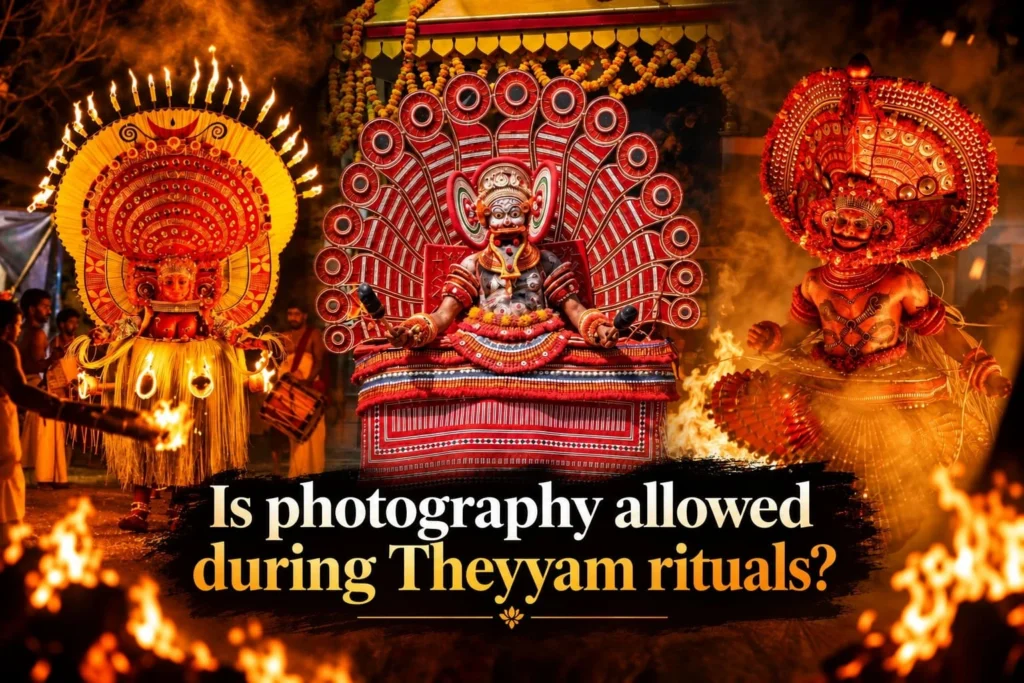
ToggleTheyyam is not a cultural performance you photograph from a safe distance — it’s a living ritual, performed at close range, often in firelight, and often by a person the community believes has become a god for the night. Get the etiquette wrong and you won’t just miss the shot; you’ll be asked to leave a sacred space.
Photographing Theyyam is generally welcomed, but it requires prior permission from the temple committee or family hosting the ritual, no flash, respectful distance from the performer and devotees, and dark-tolerant gear, since most performances happen at night by firelight between October/November and May in Kannur and Kasaragod districts, North Kerala.
This guide covers when and where to go, how to get permission, what gear and camera settings actually work in Theyyam’s mixed firelight and darkness, and the etiquette rules that keep you welcome at the next performance too.
What Is Theyyam, and Why Is It Such a Demanding Subject for Photographers?
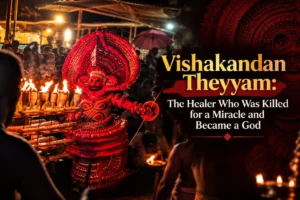
Theyyam is a ritual art form from North Kerala’s Malabar region in which a performer, after hours of makeup, costuming, and ritual preparation, is believed to become the physical embodiment of a deity or deified ancestor. It is practiced predominantly in Kasaragod, Kannur, and neighboring districts, where the people of the region consider Theyyam itself a channel to a god.
That belief structure is what makes it hard to shoot well:
- It’s worship, not theatre. Devotees are there to seek blessings, not watch a show — your camera is a guest in that, not the main event.
- It runs on firelight, torches, and trance movement — the opposite of controlled studio conditions.
- There are over 400 documented forms of Theyyam, each with its own costume, pace, and ritual sequence, so “one shot list fits all” doesn’t work.
- Access is community-controlled, not ticketed — there’s no box office to negotiate with.
Internal link: For the full ritual background and meaning, see Theyyam Season 2026–27: Complete Travel Guide.
When Is the Best Time to Photograph Theyyam?
The Theyyam season runs roughly October/November through May, with the busiest performance window in December and January, when multiple kavus (sacred groves) and temples across Kannur and Kasaragod hold performances on the same nights.
| Period | What to expect for photography |
|---|---|
| Oct–Nov | Season opens; fewer performances, easier access, smaller crowds |
| Dec–Jan | Peak season; multiple performances nightly, best variety of forms, most crowded |
| Feb–Mar | Still active; good balance of access and crowd size |
| Apr–May | Season winds down before monsoon; fewer dates, confirm availability locally |
Exact dates shift every year and are set by the Malayalam calendar, not the Gregorian one, so don’t rely on a fixed date from last year. Kerala Tourism publishes a Theyyam calendar annually, but dates and locations often change at the last minute, so confirming locally — through a homestay host, local contact, or the temple committee — is essential.
Check current dates in Theyyam Season 2026–27: Complete Travel Guide before booking travel and read a first-hand account of a pre-dawn shoot in Why Thousands Stay Awake All Night to Witness Theyyam before booking travel.
Where Can You Photograph Theyyam in Kerala?
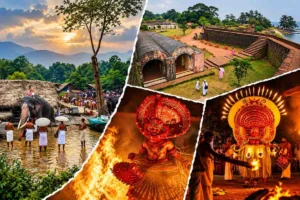
Theyyam is concentrated almost entirely in Kannur and Kasaragod districts, with smaller pockets in parts of Wayanad and Kozhikode. Within Kerala, it’s performed predominantly in Kasargod, Kannur, and Mahe districts, the Mananthavady taluk of Wayanad, and the Vadakara and Koyilandy taluks of Kozhikode. It is performed at kavus (sacred groves), family shrines, and temple courtyards — rarely in a purpose-built venue.
Practical implications for a shoot:
- Kannur town is the most practical base — closest airport (Kannur International), most homestays with local Theyyam contacts.
- Performances happen in scattered villages, often reachable only by road, sometimes down narrow lanes to a family compound.
- There’s no central listing of “which kavu, which night” — this is where a local host or homestay earns their fee.
For a Kannur-based itinerary, see Kerala’s festival calendar.
How Do You Get Permission to Photograph a Theyyam Performance?
You get permission by asking the temple committee, the performing family, or your local host in advance — never by showing up and shooting first.
Because Theyyam happens on private or community land, not a public venue, permission isn’t a formality — it’s the difference between being welcomed back and being asked to leave.
- Go through a local contact. A homestay owner, a Kannur-based fixer, or a photography tour operator who already has standing relationships with kavus will get you access far faster than a cold approach.
- Ask before the performance starts, not during it. Approach the temple committee or organizing family on arrival, explain you’d like to photograph, and follow whatever boundary they set.
- Expect to be told where you can and can’t stand. Some kavus restrict photographers to a fixed zone; respect it even if the angle isn’t ideal.
- Some performances are closed to photography entirely — particularly smaller family-only rituals. If told no, that’s final.
For what this looks like in practice at a real village kavu — including phone-on-silent, no-photographing-devotees-without-awareness etiquette — see Why Thousands Stay Awake All Night to Witness Theyyam.
What Camera Gear Do You Need for Theyyam Photography?
Theyyam photography is a low-light, no-flash, fast-moving-subject problem, which shapes every gear choice:
- Camera body: Prioritize high-ISO performance over resolution — a body that stays clean at ISO 3200–6400 will save you more shots than extra megapixels.
- Lenses: A fast standard zoom (f/2.8) for close ritual detail, plus a longer telephoto (70–200mm f/2.8 or similar) for the fire-jumping and trance sequences where you can’t get close. A wide prime (24mm or 35mm, f/1.8 or faster) for environmental shots in tight courtyard spaces.
- No flash, no tripod-heavy setup. Flash is disruptive and considered disrespectful during ritual moments; a monopod is more practical than a tripod in a moving crowd.
- Extra batteries. Cold-start shoots often run from evening prep straight through to a pre-dawn finish — be prepared for an erratic, extended schedule, as some sessions run from evening preparation into early morning.
- A rain cover / dust protection, since kavus are outdoor, uneven, sometimes smoky from torches and fire.
Cross-reference this with your gear notes in North Malabar temple etiquette guide.
What Camera Settings Work Best for Theyyam Night and Fire Photography?
Shoot manual or aperture-priority at your widest usable aperture, ISO 1600–6400 depending on how close the fire is, shutter speed no slower than 1/125s to freeze movement, and a warm custom white balance to avoid the camera fighting the torchlight.
- Aperture: Wide open (f/1.8–f/2.8) for available-light gathering; stop down slightly only when you’re close enough to firelight to overexpose.
- Shutter speed: 1/125s minimum for dance movement; 1/250s+ if you’re trying to freeze fire-jumping sequences.
- ISO: Start at 1600 in torch-only light, push to 3200–6400 as needed. Noise is more forgivable than motion blur here.
- White balance: Set a custom/manual Kelvin value (roughly 3000–3500K) rather than Auto — Auto WB will constantly hunt against firelight and produce inconsistent skin tones across a sequence.
- Focus mode: Continuous/AI Servo tracking with a single expanding focus point — Theyyam performers move unpredictably and fast during trance sequences.
- Format: Shoot RAW. The dynamic range between fire highlights and shadow-heavy courtyard backgrounds needs recovery room in post.
If you’re deciding between stills and motion for a fire sequence, our Theyyam video gallery shows how these movements actually read in footage versus a still frame.
What Are the Etiquette Rules for Photographing Theyyam?
Believers see the Theyyam performer as a visible manifestation of God — a channel to communicate with their deity and seek blessings from — so respecting that belief, and not causing any hindrance to devotees’ view of the performance, matters more than getting the shot.
- Never touch the performer or their costume, even after the performance ends.
- Stay in your assigned space. Don’t shoot over devotees’ heads or block their sightline.
- Dress modestly — avoid shorts or sleeveless tops, since the performance happens within temple premises.
- No flash, ever, during ritual sequences.
- Ask before photographing preparation (makeup, costuming) up close — some performers/families allow it, some don’t.
- Don’t direct the performer for a “better angle.” This is worship, not a photoshoot.
Which Theyyam Forms Give Photographers the Most Dramatic Shots?
Not all of the 400+ forms suit the same shot list. A few that consistently offer strong photographic material:
| Theyyam form | Why it’s photogenic |
|---|---|
| Theechamundi / Fire Theyyams | Fire-jumping, ember-dancing sequences — dramatic, high-contrast light |
| Kathivanoor Veeran | Elaborate costume and headgear, strong narrative pose |
| Muchilottu Bhagavathi | Detailed face painting, slower ritual pacing (easier to compose) |
| Pottan Theyyam | Distinctive mask and movement style, strong graphic contrast |
| Kandanar Kelan | One of the fastest, most fire-intense forms — the performer charges and stomps directly through a blazing pyre, making it a strong pick for peak-action fire shots |
| Kandakarnan | Fierce guardian-deity form with bold, high-contrast makeup and forceful movement — good for tight facial/expression portraits |
| Thee Kuttichathan | Fire variant of Kuttichathan, a guardian-deity Theyyam — combines flame work with a distinctive mask, useful for both wide fire shots and detail shots |
| Vishnumoorthy Theyyam | Combines fire elements with elaborate costume detail |
See these forms already captured in our Theyyam image gallery and the full list of Theyyam types before you build your own shot list.
Conclusion
Theyyam rewards photographers who treat it as a ritual first and a photo opportunity second: get permission before you shoot, leave the flash at home, dress and stand appropriately, and build your gear and settings around firelight and unpredictable movement rather than fighting them. Do that, and you’ll come away with images that tour-operator photo galleries rarely capture — because you’ll have actually been let in close.
For confirmed 2026–27 season dates and a Kannur-based itinerary, read the full Theyyam Season 2026–27: Kerala Theyyam Tour.
FAQ
Is photography allowed during Theyyam rituals?
Generally yes, but it isn’t automatic. You need permission from the temple committee, the hosting family, or a local contact before shooting — Theyyam happens on private or community land, not a public venue, and some smaller family rituals may not permit photography at all.
Can I use flash while photographing Theyyam?
No. Flash photography is considered disruptive and disrespectful during ritual sequences, and most kavus and temple committees won’t allow it. Rely on high-ISO capability and fast lenses instead.
What is the best month to photograph Theyyam in Kerala?
December and January are peak season, with the most performances happening across Kannur and Kasaragod. October–November and February–March offer a good balance of access with smaller crowds.
Do I need a permit or fee to photograph Theyyam?
There’s no standard government permit. Access is granted informally by the temple committee or hosting family, sometimes through a local host or homestay who already has a relationship with the kavu. Some private tours include pre-arranged access as part of the cost.
What lens is best for Theyyam photography?
A fast telephoto (70–200mm f/2.8) for fire-jumping and trance sequences you can’t get close to, plus a fast wide-to-standard zoom or prime (24–35mm, f/1.8–2.8) for environmental and preparation shots in tight courtyard spaces.